

How Many Principles of CST Are There?
MH as starting a conversation
I like to start my courses in Catholic Social Thought by asking my students a question which I know will elicit multiple conflicting answers. One can find many lists of principles (or are they themes?) of CST online. The USCCB define seven. Other sources offer lists of three, four, eight. nine, or ten. Human dignity and solidarity appear on nearly every list, but there is a great deal of variation on the rest. Should we include the call to family, community, and participation (or just participation?); the option for the poor (and vulnerable?), subsidiarity; the role of government; the common good; stewardship (or care?) of creation; the priority of labor (or the dignity of work or rights of workers?); rights and responsibilities; peace (and just war?); and/or the universal destination of material goods? It’s not completely clear. Exposing students to multiple lists helps me drive home the complexity of the tradition of CST which has a consistent core, develops over time, and remains contested. I frame the course with my own list of principles and try to help them to see CST as an ongoing conversation to which they are invited to contribute.
Magnifica Humanitas both confirms and complicates this view of CST (or Catholic Social Doctrine), and that probably means I’m going to need to revise my syllabus next year. Most of the conversation around the encyclical has focused on the contrast between the tower of Babel and the civilization of love, and ethical guidance on AI. But, as David Cloutier points out on this Substack, the beginning of the document includes “a full-scale meta-analysis of the nature and history of ‘social doctrine.’” At First Things, Joshua Hochschild claims that MH “refounds and ratifies social teaching as a primary mode of the Church’s engagement with the world.” Clearly, something is going on, but moral theologians have been so busy communicating the AI-specific content of MH that they haven’t had time to explore the narration of Catholic social thought which consumes the first two chapters of the document.
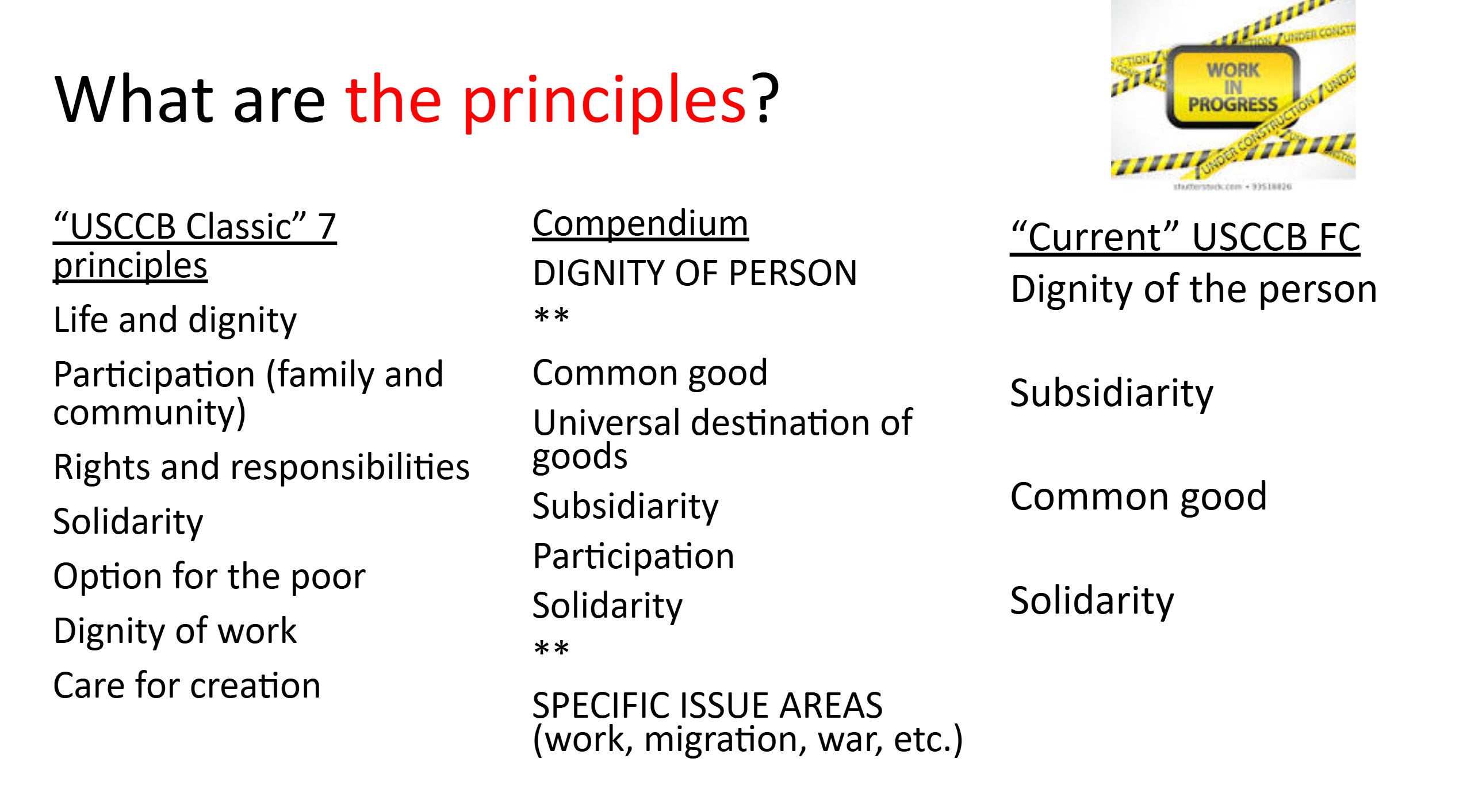
One place to begin that reflection is to consider MH’s list of social principles. Human dignity and rights are now understood as the foundation anchoring five principles: the common good, the universal destination of material goods, subsidiarity, solidarity, and social justice.
What is notable here? Human dignity is not simply first in a list, but situated as the foundation of the other principles, explicitly linked to equality and human rights. The principles that follow are, well, principles, not themes. The universal destination of material goods is included, as it is in the Compendium, but few other lists. Solidarity includes a call for participation and is specified by the option for the poor. Subsidiarity covers all intermediary groups, including families, and, along with the common good, frames MH’s claims about the role of government. Social justice defined as, “the capacity of a social, economic and political order to allow everyone — particularly the weakest — to live a truly dignified life, without leaving anyone behind” (no. 77), is elevated in a new way.
What is left out? As Leo continues to decenter just war theory in favor of a focus on nonviolence and just peace as the church’s prophetic contribution in conflict situations, it is not surprising that it does not appear as a principle. However, in a document released on the 135th anniversary of Rerum Novarum and broadly understood as a response to the present and coming labor crises, it is interesting that neither the rights of workers nor the priority of labor is included as a principle, though MH is marked by an insistence on respect for dignity and rights more generally. The absence of the option for the poor, stewardship of creation, and the call to family is perhaps even more surprising. Family has been a unique and central part of the Catholic vision of the social order from the beginning of CST (see chapter two of my Family Ethics: Practices for Christians). The option for the poor came to occupy a central place in the tradition (see Dilexi Te, nos. 82-102) through dialogue with liberation theology in the latter part of the twentieth century and Laudato Sí compellingly articulated the church’s commitment to the environment in the context of its social teaching in the twenty first century. It seems that poverty, work, family, and the environment are now understood as particular issues to be considered in the light of more general principles. I have some concerns about this approach, but I’ll be reframing my syllabus around the one foundation and five principles articulated in MH and rethinking my first assignment.
What won’t change is the interplay of change and continuity in the Catholic social tradition as a central course theme. MH clearly situates the tradition in the context of history, is open about its development and about the church’s failings. It invites us to see CSD not as “a handbook of principles and norms to be applied, but a process of shared discernment. It is born from the encounter between the eternal truth of the Gospel and the questions of history. It allows itself to be challenged by the signs of the times, and draws nourishment from the contributions of science, culture and human experience” (no. 27). That’s a vision I want to teach, even if we keep arguing—and I hope we will--about the details.