

There will be many days and many ways in which to comment on Leo XIV’s first social encyclical, Magnifica Humanitas. As a scholar of the history of CST, I was particularly intrigued to find a full-scale meta-analysis of the nature and history of “social doctrine” at the beginning of the encyclical, one that shows in particular the contributions of Cardinal Michael Czerny and Anna Rowlands.
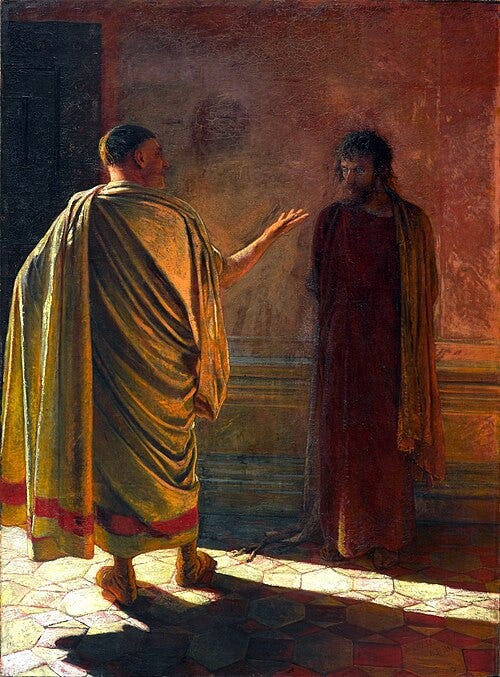
Nikolai Ge: “What is truth?” Christ and Pilate; from https://commons.wikimedia.org/wiki/File:What_is_truth.jpg
But in terms of content, an initial place to focus, I want to focus on the discussion of truth and communication in chapter 4. The architecture of the encyclical overall is quite clear. Although long, the encyclical ends up having three main parts: a fundamental analysis of artificial intelligence as an instance of the technocratic paradigm in chapter 3, a broader overall analysis of politics and culture in chapter 5, and then a more focused threefold application in chapter 4, to “truth, work, and freedom.” I like this structure, particularly the choice to specify particular areas of concern that are neither the 30,000-foot “civilization of love” level nor the nuts and bolts of the “new thing” level. The chapter urges us “to rediscover truth as a common good, to protect the dignity of work and to safeguard freedom against all forms of dependence and commercialization.” These are extremely important implications that proceed directly from, but flesh out, the human dignity claims that are at the forefront of the prior chapter.
The concern about un-truth is not new, the encyclical acknowledges, “yet today it finds a powerful amplifier in AI.” (132) Indeed, the document does not limit the concern about truth to “mixing facts with opinions,” but also quotes Pope Francis arguing that the wrongness of murder cannot be understood as a mere social convention, but “a non-negotiable truth attained by the use of reason.” (133) It further argues, in various ways, that truth is a relational, collective good - Leo points out that truth arises in contexts of social trust, is necessary for any deliberative democratic governance, and appears with a larger cultural imagination that “presents a particular vision of reality as desirable.” (136)
The core argument is then offered that truth is a common good, and thus (much like the earth and other environmental resources) requires attention to an “ecology of communication.” This involves various responsibilities:
On the level of public policy, this entails establishing norms so that the decision-making behind content selection and its development becomes more transparent and protects personal data. Regarding social and cultural aspects, this requires a strengthening of intermediary organizations, serious journalism and forums for debate, where reasoned argumentation and verification carry greater weight than immediate reaction. For families and schools, there is a growing need for new educational awareness and for formation concerning the proper and critical use of digital tools, AI and online commercial and financial platforms. In universities, the principal challenge lies in the integration of knowledge, cultivating both the capacity to connect and synthesize knowledge in order to grasp complexity, and the skills necessary to verify facts.
There are some striking things said about the importance of parental choice in education and the need for age limits on technology. But it is particular worth pondering the several places which emphasize quite clearly what education is supposed to be about. Leo writes that “As knowledge becomes increasingly fragmented, it becomes difficult to grasp reality as a whole, to ask profound questions about meaning, or to develop authentic, critical and creative thought,” and insists later in the paragraph that “a genuinely healthy attitude is needed, requiring rhythms that incorporate silence, in-depth study, reading and judicious analysis, for without these elements inner freedom may be compromised.” (146) I wish I could report that this is what university structures actually emphasize, but they often do not. More directly, it is folly to think that we can urge students individually to plug these things into their schedules (!!) if we do not cultivate environments that are conducive to these things. For example, the University of Notre Dame is utterly awash in screens. I don’t mean the screen in everyone’s pocket. I mean the need to put up screens flashing messages or running programs everywhere. The level of visual stimulation when I walk through the student center is bad enough, but of course, many classrooms are also full of screens, as are many other buildings. The student center adds to the problem by playing background music - not Muzak! - at levels that are too high to be background music. The same phenomena (the screens everywhere, the background music) are present in the dining hall, where most people are actually trying to engage in conversation with people (or they have their own screens and headphones!). Has no one asked, why do we need all these screens?! And this point about screens is a trivial one compared to cultivating a broader culture where focused reading and study could actually be prioritized.
Yet the most important point the pope makes is beyond these. He insists that education is about “grasping reality as a whole.” The original quote above specifically says the “principal challenge” of university education is “the integration of knowledge.” It is not collecting or transmitting knowledge as “bits”, nor “producing” knowledge as evidence of some kind of novel creativity. It is integration. But the contemporary university is structured in a way that completely militates against this integration. Disciplinary specialists are privileged in isolated departments and schools. Philosophy and theology, which are the integrating disciplines, are not taught as integrative, but their own specialized subject areas. At Notre Dame, there is an “integration” requirement in the core curriculum, but it is simply a requirement to take a class that uses materials from more than one discipline. Only this past year has the University succeeded in instituting a one-credit class for all first-year students, the Moreau Seminar, which engages classic primary texts on questions of work, friendship, meaning, roots, and other “big themes.” But that’s a bit like treating integration like an arts appreciation requirement of attending a few concerts - good as far as it goes, but it doesn’t go all that far, when it is overwhelmed by the standard fragmentary curriculum. Even worse, few of even these outstanding students come out of high school with a common set of literary texts or of a common historical memory on which one can rely.
What does this have to do with truth? In his prescient 1992 book Technopoly, Neil Postman relates a little trick he sometimes plays on colleagues, by asking first whether they read the Times that day, and if they say “no,” he then relates to them a study he read about saying, for example, that the best weight loss diet is normal meals plus chocolate eclairs, because there’s a special ingredient in the eclairs that causes weight loss, or, in another case, a study that jogging leads to reduced intelligence. As he reports it, if he acts well, about two-thirds of his interlocators will at least not disbelief what he is saying.
Postman tells this story for two reasons. One, he indicates that by citing the Times and some university doing a study, people “believe in the authority of our science, no matter what.” But his more important point is that “the world we live in is very nearly incomprehensible to most of us” because “we have no comprehensive and consistent picture of the world that would make the fact appear as an unacceptable contradiction.” This is ultimately because, “abetted by a form of education that in itself has been emptied of any coherent world-view, Technopoly deprives us of the social, political, historical, metaphysical, logical, or spiritual bases for knowing what is beyond belief” (pp. 56-58).
Hopefully the Postman story - from 1992! - illustrates well that the deepest problem with truth is the lack of some kind of comprehensive view of reality, against which falsehood clearly shows up. This is not merely a matter of AI “hallucination” - something that tends to show up only when we have a pretty strong grasp of what we doing with AI. This is a matter of cognition coherence competence, the idea that one has a map of the world in one’s head. Now, of course, we all have such maps, inevitably, and much education is now (paradoxically) devoted to debunking those maps, as if we all have grown up in some parochial monoculture that dominates our consciousness. What replaces those maps, too often, is an ideological idol. But since we give far too inadequate space in our educational system for cultivating anything like an integrated worldview, it’s very easy for people to substitute something else on the cheap. If we say we genuinely seek truth in common, we shouldn’t accept cheap imitations. Especially at universities.
Confronting this question of truth as integration as a commons problem - again, not just a matter of deciding what “I” think, but about what “we” think - is very right, and AI simply raises the bar of the challenge. Can AI be helpful in this regard? I don’t want to go down the rabbit hole about biases here, but at the very least, it’s not going to be helpful at the front end. Because AI can’t integrate - and when I say that, I mean it can’t understand what it means to “integrate” knowledge into a “true” image of “reality.” It can process Leo’s encyclical or my blog post about what integration means. But integration is a meeting of minds - a communication, in the best sense. Notre Dame continues to have at the core of its mission statement “the pursuit of truth for its own sake.” Let’s hope we all read Leo and AI - and not just say “Lord, Lord, nice words,” but actually act on them!