

Why Should Catholics Care About Democracy?
Lessons from popes and El Salvador
In recent weeks, Pope Leo XIV has been raising his voice to defend immigrants, call for peace, and decry the manipulation of religion. U.S. Vice President JD Vance suggested that the pope should “stick to matters of morality,” but the pope has emerged as a powerful voice on the global stage calling for a moral politics, and the U.S. Catholic bishops and other Catholics are speaking with him. Faith leaders have been active in protesting the presence of ICE in Minneapolis and at immigration detention centers in California, and critical of cuts to foreign aid and domestic charity programs.
Yet there is one issue that has received little serious attention from Catholics: democracy.
This is surprising because there is strong evidence that democracy is declining in many other parts of the world. “No Kings” has become the focus of protests against the Trump administration in the U.S. Political analysts on the right and left have shown the rise of authoritarianism in countries across the globe. Scholars note that, today, authoritarian regimes are more likely to come to power not by military coup but by election. Then, using legal means, those in power dismantle democratic institutions within government, disempower other social institutions, and disregard democratic norms. Some even argue that the U.S. can no longer be called a democracy, though certainly, other countries have moved even further from democratic norms.
But is this the concern of Catholics or is it enough to call out violations of human rights and dignity, as Catholics are doing when they stand up for immigrants and the poor, and call for an end to war? Is it our business to talk about political systems?
Pope Leo seems to think so. In a speech this month to the Pontifical Academy of Social Sciences as they gathered to discuss, “The Uses of Power: Legitimacy, Democracy and the Rewriting of the International Order,” the pope said that “legitimate power finds one of its highest expressions in authentic democracy … [which] recognizes the dignity of every person and calls each citizen to participate responsibly in the pursuit of the common good.” He quotes St. John Paul II’s affirmation of democracy in Centesimus Annus (1991) and echoes his caution that democracy must be “rooted in the moral law and a true vision of the human person.”
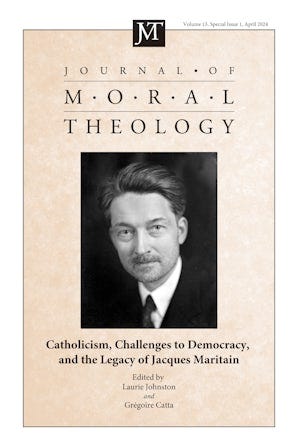
It’s not just Pope Leo and Pope John Paul II. Throughout modern Catholic social teaching, there are affirmations of the essential elements of democracy, including the rule of law, a balance of powers, and popular sovereignty which are linked to CST principles of human dignity, subsidiarity, and participation. In the early 20th century, the Catholic church was agnostic about forms of government and lent its support to authoritarian regimes. But in the mid-20th century, with help from John Courtney Murray and Jacques Maritain, it came to embrace democracy as the imperfect best option for politics. And it kept insisting that authentic democracy had to be linked to basic truths, most importantly human dignity and human rights.
All of this might sound abstract, depending on who you are and where you live. I spent much of the fall semester in El Salvador, where authoritarian government means: a mix of armed police and military patrolling streets, shops, and parks; changes to the Constitution to reduce the power of their legislative body and extend presidential terms indefinitely; over 80,000 people in prison without due process. While grateful for streets no longer ruled by gang violence, the vast majority now live in fear of offending the government and joining the 80,000 incarcerated under President Bukele’s “state of exception,” who have little hope of ever getting out. All of this makes speech, protest, and political advocacy too dangerous to take up, except for the very brave.
Living under advanced authoritarianism in El Salvador while reading about democratic decline in the U.S. convinced me of the urgency of political activism here. Democracy does not guarantee human dignity or human rights but, without it, it is nearly impossible to fight for either. Catholics legitimately claim the freedom to choose their political party, but we should all care about democracy, because it aspires to limit the power of sovereigns, affirm the rule of law, balance powers within government, and respect human dignity by giving people voice and vote.
And if tempted to despair about its imperfections and decline, we should, as Leo suggests, ground our hope in the “Kingdom of God.” Not via a distorted Christian Nationalism that seeks to integrate church and government. Instead, with a healthy sense of the limits of politics, we can work for a more authentic democracy, where “the logic of charity” trumps the logic of fear.