

What is a fair price? Senator Elizabeth Warren has recently weighed in against the advent of so-called “dynamic pricing,” provoking a typical market-defending response from the Wall Street Journal columnist Matthew Hennessey, and another from the editorial board at the Washington Post, arguing that “price controls” are a far greater threat. The term “price gouging” is one of those terms in a language that carries moral weight in its description. Call it a “discount” when attending a movie matinee, but call it “gouging” if the movie theatre charges you more on the first weekend a film is released!
The idea of price gouging is one of these places where our ordinary moral intuitions and the typical economist view sharply diverge. (So are price controls, but that’s another, not-unrelated post!) Economists insist that, say, increasing the price of lumber in a city where there has been a natural disaster is not “gouging”; rather, it “signals” to lumber producers to produce more lumber or (more importantly) direct more lumber shipments to the area of greatest need. Now that I have an office in a business school, I can get more such ideas easily. Senator Warren used the example of the ice cream stand charging more on a hot day; a colleague noted that this is fair, because the business will in fact create more supply by hiring more employees, so the line is shorter. There is “more” ice cream - or more precisely, you trade off the higher price for a shorter wait in line (made even shorter because others will decide they’d rather do something else than get ice cream at that price). Another colleague noted that, in a market, basically all pricing is dynamic - that’s the whole point. We expect grocer to put berries on sale at certain times of the year, and to charge a premium at other times. Gas stations change their prices daily (or sometimes more often), and we might not like it, but we know why it happens. When Uber first introduced “surge” pricing, there was great outcry against the idea that “the same trip” might cost different amounts at different times - but now, we (I?) kind of accept that ridesharing fares will vary, in part because it is evidently the case that higher fares will mean more drivers come out.
These examples should indicate to us how much our sense of what “fair pricing” is involves custom. As we know, many places in the world even today don’t post prices in stores; the custom of a one-posted-price-for-all, according to Planet Money, was introduced by Quakers, who felt it was unfair that the same item was sold to different people at different prices. In the United States, posted prices became the standard in part because of the rise of the department store, which essentially “de-skilled” an element of the job of store clerks. As already noted, aspects of “dynamic pricing” are already seen in the widespread longstanding practice of discounting movie matinees or Christmas cards or “senior citizen days.” Of course, when it’s framed as a discount, consumers rejoice. As Hennessey’s response notes, there is no “Big Ice Cream” that somehow completely dominates the market; if one stand or chain does this, express your displeasure by patronizing the businesses who stick with standard pricing.
The varied examples could continue indefinitely, and they should make us aware that it’s hard to make blanket proncouncements about the danger or merits of any one model of pricing. But are there any moral principles by which we might judge the combination of custom and market? It seems to me we might (non-exhaustively) name two - like just war principles, they don’t translate exactly into an “answer” for any particular case, but they do offer guidance for prudential judgment.
The first is the underlying sense that pricing should not “take advantage” of another. Aquinas’s treatment admirably notes both sides of this: the seller should not take advantage of the buyer, but also the buyer should not try to take advantage of the seller. The notion of “taking advantage” is a tricky one, but possibly the most valuable to interrogate. All those used book “bargains” I got back in the day from sellers who didn’t realize a particular book was “worth more” - maybe I was taking advantage of some small-town used bookseller! But more relevantly, even the Yale finance professor Robert Shiller, in trying to defend the practice of finance, insists that a sense of reciprocity governed by the Golden Rule is necessary for financial markets to work - it doesn’t mean people need to be nice. It does mean that, if you would not want to be “taken advantage of” in this way, you should not “take advantage of” others in the same way. I leave it to more expert people to determine the extent to which today’s financial markets do or do not conform to Shiller’s ideal. But he’s right about the underlying sentiment: what’s fair is what you would expect if you were on the other side of the bargain.
The second principle is pricing that preserves the importance of what economists call “consumer surplus.” What consumer surplus indicates, in a simplest form, is the willingness of the market to provide a good or service at a price that is considerably cheaper than what I am willing to pay. This phenomenon is especially important as a kind of side product of mass production; in economic theory, firms produce things to the extent that they can sell the marginal unit at such and such a price. But if they sell at the widgets at the price on the margin - meaning the lowest price someone in a line will pay - then those in the line who would have paid more still get the widget for the lowest price. In a society of mass production, we are constantly “getting bargains” in the sense that producers charge a lower price than we would otherwise be willing to pay. It seems to me we often overlook the extent to which ongoing experiences of consumer surplus - that is, getting things more cheaply than you expect - is crucial to sustaining a sense of widespread economic prosperity.
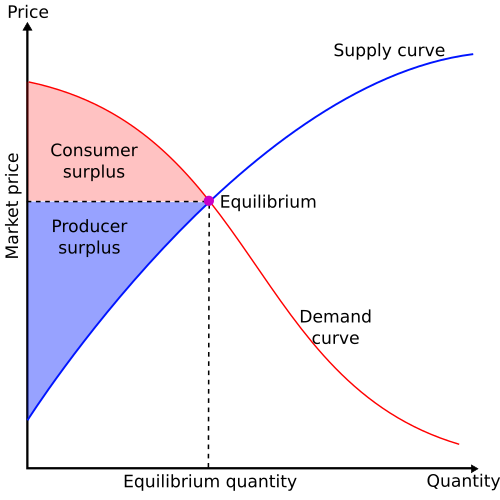
From https://commons.wikimedia.org/wiki/File:Economic-surpluses.svg
From these examples, one can see that it would be in the firm’s self-interest to increase their producer surplus - produce things more cheaply that people are willing to pay a premium for. Brand-name sodas and shampoos are like this (which is why Aldi or Suave are so much cheaper!). But in fact, what they’d like to do is raise the price to whatever maximum each buyer is willing to pay. At the extreme, this means firms would like to charge rich customers more - and they do have ways to do this, like different trim lines of cars, for example, or different airline seats, or different price packages at Disney. The idea of charging rich customers more seems like it should be appealing to Senator Warren!
And certainly dynamic pricing will extract money from rich people. The dynamic tolling lanes in northern Virginia, where one might have to pay $40 or $50 for a commute day, are not going to be a big sacrifice for the millionaire lawyers and lobbyists. But as “efficient” as the variable, traffic-based “dynamic tolling” is, the niggling sense of the moral problem creeps into the picture, too: what’s going on here in these so-called “Lexus-lanes” is not simply squeezing rich people, but squeezing out poor people - OR squeezing them much more tightly, if they have no way around the cost. $40 for them matters more than $40 for the rich person - a point that economic models willfully ignore, to their discredit. In other words, the reduction of the consumer surplus, while it may hit rich people in a higher absolute quantity, will impact both the actual budget and the quality-of-life of the poor person much more.
I think there is something good - something fundamentally egalitarian - about posted fixed prices, even if those prices are somewhat tiered or offer “discounted” periods to incentivize having people in a restaurant at 4pm. But if what sellers aim at is ruthlessly eliminating consumer surplus by “optimizing” pricing, what you will ultimately do is squeeze the people who are already the most squeezed - and further promote a sense of a society like the above-mentioned experience of stratified Disney or the plane: some people sit up front, have status, and enjoy everything, and some people are herded into whatever spots are left. Yes, there are economic arguments for differentiated price model that do make sense. But let’s not forget that pricing customs also affect our day-today sense of who belongs and who is prioritized in a social order - and also involve the exercise of power that allows some to “take advantage” of others.