

Thirteenth Sunday of Ordinary Time:
Rewards and Consequences (Not Karma)
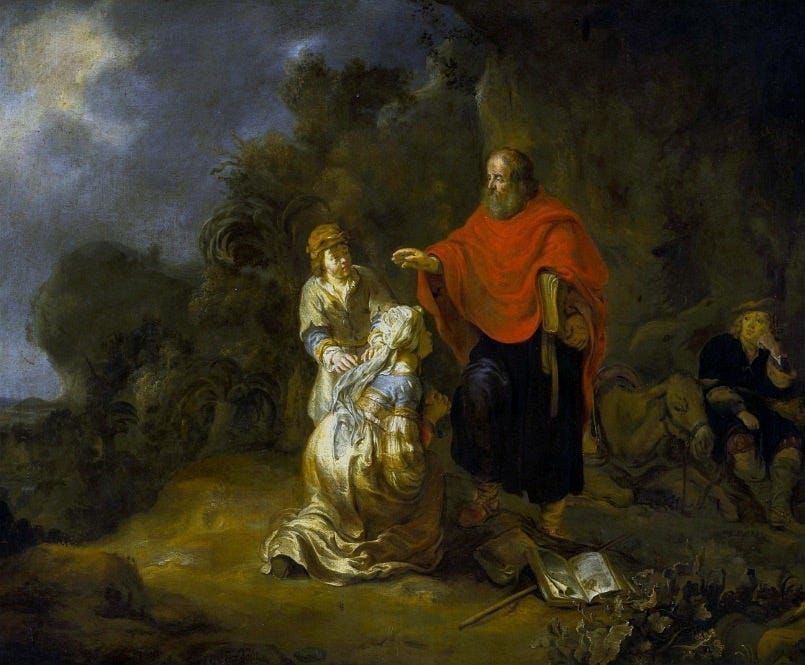
The image above is Gerbrand van den Eeckhout’s 1649 painting “Elisha and the Shunamite Woman,” which is in the public domain, accessed from Wikimedia Commons.
Readings for the Thirteenth Sunday in Ordinary Time
“Karma” is a concept we hear mentioned often these days, whether as the title of a popular Taylor Swift song or as an easy explanation for an event. This ancient Indian idea indicates that a person’s intentional thoughts, words, and actions influence the future in a causal way; this is seen as a natural law. For Indian religions such as Hinduism and Buddhism, karma is also linked to reincarnation. These religions believe the accumulation of karma in one life determines the shape of the person’s next life on earth.
We can see where the idea of karma may be compelling or make sense to us at some level; it’s no wonder that even Christians will turn to karma to try to understand why something good or bad has happened. However, our own Catholic tradition has a different and even richer concept rooted in a loving God, and this is evident in our readings for today.
The first reading from 2 Kings presents a nice story from the life of the prophet Elisha, who is graciously hosted by a “woman of influence” in Shunem. Elisha is so moved by her hospitality in setting up a guest room for him that he wants to do something for her as thanks. Elisha’s servant knows that what she really wants is a son, and in biblical miracle fashion also seen with women such as Sarah, Hannah, and Elizabeth, Elisha informs her she will have a son.
Thus we see the woman is rewarded for her kindness. Yet this reward is beyond a concept of karma; karma does not account for miracles coming from the hand of God through a prophet. Moreover, prolonged infertility cannot be cured simply by graciously hosting a visitor. We know there is no such direct causality in a karmic way, nor did this woman expect such a repayment. What makes this remarkable is that the reward exceeds the good deed in a way that indicates a supernatural world encompassing the natural world. This is no basic cause and effect in a closed natural system, but rather shows a world that has a divine actor moved by love.
And yet, as with the ancient Indian concept of karma, we do believe we are responsible for our thoughts, words, and deeds. In the confiteor at the beginning of Mass, we communicate our responsibility for our sin quite clearly: “I confess to Almighty God and to you my brothers and sisters, that I have greatly sinned, in my thoughts, in my words, in what I have done, and in what I have failed to do.”
And although we don’t believe in karma, we believe that sins have real consequences. At the natural level, we have all probably experienced this. Someone who embezzles money from an organization may be caught and punished, which is a natural consequence. Or they may not be caught but the organization has to file for bankruptcy. Another natural consequence is that the person develops a vice of deception. Sometimes, a sin from years past can have an unexpected natural consequence even many years later. And another regular consequence of sin is that it ruptures relationships with others.
However, as with good deeds, we see that sin does not operate in a closed natural system, particularly because it is an offense against God. Thus there are supernatural consequences to sin as well. Sin ruptures our relationship with God. Sin causes division in the body of Christ, the Church, which should be characterized by unity. Sin damages our souls, and it can also leave us feeling quite hopeless, as though we will never be good enough to merit heaven.
Yet this is precisely the opening that we need to recognize the supernatural perspective we have. We are not condemned to be reborn as the lowest caste, punished karmically for our bad deeds. Rather, in his great love, God sent his only Son to us (John 3:16). Jesus emptied himself and became human, obediently accepting death on a cross (Phillipians 2:5-11). In today’s second reading from Romans, we hear, “As to his death, he died to sin once and for all; as to his life, he lives for God” (Romans 6:11).
The message is entirely one of hope. To borrow the words of the biblical scholar Gary Anderson in his book Sin: A History, God has gamed the world in our favor. Yes, sin has natural and supernatural consequences, but we do not need to rely on ourselves or expect karmic justice from an unfeeling universe. We are saved through Jesus Christ, who reveals God’s love for us in his life, death, and resurrection. Our recognition of our sins and our repentance, our vulnerability and brokenness that leads us to depend on God, our willingness to admit we are doomed without Christ’s salvific work – these all provide a richer picture where God’s mercy transcends his justice. As represented by Elisha, God wants to give us more than we deserve; God will reward the good deeds, as Jesus states in today’s gospel from Matthew. Jesus also states: “Whoever does not take up his cross and follow after me is not worthy of me. Whoever finds his life will lose it, and whoever loses his life for my sake will find it” (Matthew 10:38-39).
What might be the implications of all this? First and foremost, our faith is one of relationship with God, not a faceless principle of the universe. Secondly, we believe that our thoughts, words, and deeds have natural and supernatural consequences, so we have to attend to them: to avoid sin, to acknowledge sin, to do penance for sin, and to seek to grow in virtue through intentional good deeds. Third, we do all of this knowing that God wants us to win; he wants us to have eternal life with him. In his mercy, he gives us so many resources to help us: the sacraments, especially the Eucharist and Confession, the lives of the saints as models, sacramentals such as holy water and rosaries, the Bible for our edification, the support of our friends and family, the beauty of nature for inspiration, etc.
Fourth, when we face difficulty, we see it as an invitation to take up our cross and follow Jesus. One of the best arguments against karma is that bad things often happen to good people (and God allows this in allowing humanity’s free will, often using bad things to draw us closer to him) and also, good things happen to bad people (and God allows this likewise!). When we are wronged, we don’t “leave it to karma,” but we do put it into God’s hands, trusting that he will bring about natural or supernatural justice somehow in his own time. At the same time we don’t “leave it to karma” when we see injustices in the world around us. We are called to advocate and work for justice, doing the good deeds that will be rewarded.
We are far from despair with such an understanding. And as we continue walking and praying through these weeks of Ordinary Time in the midst of summer, we take up our cross and follow Jesus, acknowledge and repent of sin, become part of the body of Christ in the Church’s sacrament of the Eucharist, and seek to live good lives, trusting in God’s reward.
 | A guest post by
|