

The Ordo Amoris, U.S. Policy, and a History of Anti-Immigrant Nativism
by Emily Dumler-Winckler
Editor’s Note: This post is a part of a series of responses to Stephen Pope’s essay “Revisiting the Ordo Amoris: A Contemporary Interpretation of a Classic Christian Theme.” The series is curated by Alessandro Rovati, the Associate Editor of the Journal of Moral Theology.
Stephen Pope’s essay provides a characteristically lucid exposition of the ordo amoris in the tradition of Catholic moral theology. It is also a characteristically generous response to Vice President J.D. Vance’s efforts to use the ordo amoris to justify this administration’s “America First” policies. Pope provides an instructive corrective for the VP and others who have oversimplified or misunderstood the ordo amoris, ignoring “authoritative voices from [their] own Catholic tradition.” Because the ordo amoris is at the heart of the Christian moral life and because the concentric and hierarchical simplicity of Vance’s interpretation is ultimately misguided, Pope’s response is timely and imperative. The ordo amoris or ordo caritas tradition, Pope suggests, entails a certain simplicity and complexity, but not of the sort that Vance envisions.
On the one hand, ordering our loves is a matter of exercising the virtue of caritas by loving God, self, others, and creation. On the other hand, what this entails with respect to family, neighbors, strangers, and specifically the poor, refugees, and immigrants requires ongoing discernment for Christians and Christian communities no less than for American policy makers. In short, I agree with the three central points of Pope’s essay: the Christian moral life is essentially a call to love God, God’s creation, neighbor, and self, to discern how to order our loves given our diverse roles, relations, histories, and social contexts, and to prioritize the needs of the poor and oppressed, both at home and abroad.
The implications of Pope’s essay for U.S. immigration policy seem to be the following.
First, because the ordo amoris is not simply a matter of expanding concentric circles, it does not justify, as Vance argues, a set of “America first” policies that neglect the needs of refugees, immigrants, or the global poor beyond U.S. borders. Second, the ordo amoris, rather, calls followers of Christ to pay special attention to the needs of fellow Christians, the poor, neighbors, and strangers at home and abroad. This does not settle the matter of precisely what U.S. immigration policy should be, but it does point to an alternative order of loves and priorities than those outlined by Vance and the current administration.
Because Vance uses his interpretation of the ordo amoris to defend this administration’s “America first” policies and practices, a full response warrants not only Pope’s insightful instruction on the ordo amoris, but also attention to the nativist, anti-immigrant, and white Christian nationalist sentiments that bolster this agenda. Indeed, as Pope notes, faithfully discerning what the ordo amoris entails requires attention to history, power, social context, roles, and relations. The assertions, policies, and priorities of the Trump-Vance administration reflect a nativist, anti-immigrant, white Christian nationalist vision of “America first,” one that is profoundly unchristian and has roots at least as deep as the nation itself. Especially amid the fanfare of America’s 250th Anniversary as a nation, we do well to recall that American Christianity has been a double-edged sword: some strands have bolstered indigenous genocide, slavery, nativism, and their afterlives, while others have ignited movements for liberation, abolition, justice, hospitality, and more egalitarian forms of American democracy.
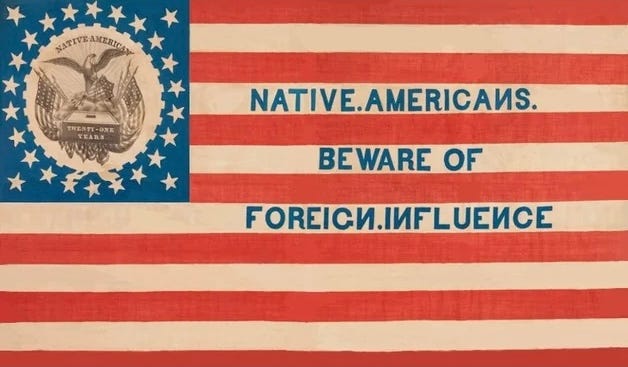
Historically in the U.S., nativism—”an ideology, governmental policy, or political stance that prioritizes the interests and well-being of native-born or long-established residents of a given country over those of immigrants”—has not only restricted immigration for certain groups, but has also done so by promoting xenophobia, racism, white supremacy, and white Christian nationalism. Vance is not the first to make such arguments and will not be the last. Ironically, given Vance’s appeal to the ordo amoris, some of the most prominent early proponents of nativist white Christian nationalism, such as the “Know Nothing” Party, used scripture and theology to defend not only chattel slavery but also their aggressive anti-Catholic, anti-immigrant Protestant nativism.
There is room for sincere disagreements and arguments about the best immigration, refugee, and political asylum policies. But it is also important to distinguish reasonable arguments about immigration from nativist assertions, rhetoric, and policies. For instance, when Vance falsely claims that immigrants create “ethnic enclaves” which spur violence and crime; or spreads calumnies about Haitian immigrants; or refuses to condemn the heinous—misogynistic, homophobic, racist, and antisemitic—messages of the leaders of the Young Republicans organization; or, rather, condemns Rene Good, the mother of three who was shot and killed by an ICE agent during the siege of Minneapolis, as a “deranged leftist” whose death was a “tragedy of her own making;” or uses terms like “illegal immigration” to characterize all forms of immigration; or approvingly normalizes Americans who “want to live next to people [with whom they] have something in common,” and not next to people who speak a “different language” or come from “a totally different culture,” he echoes and condones centuries-old arguments of American nativists and leaves the realm of reasonable argument or policy design. Indeed, the Trump-Vance team has only sharpened the anti-immigrant nativism that fueled Trump’s initial rise to power in 2016, “seizing on scare tactics, falsehoods and racial stereotypes” about “illegal aliens,” “invading,” and taking American jobs and homes. What Republican governor of Ohio, and Trump-Vance supporter, Mike DeWine wrote in response to their claims about Haitians could apply to nativist rhetoric more broadly: “Their verbal attacks against these Haitians — who are legally present in the United States — dilute and cloud what should be a winning argument.” Such nativist statements have not only diluted and clouded but have mostly replaced arguments for specific immigration policies.
Vance’s appeal to the ordo amoris does not just commend a parochial vision of Christians loving their family, neighbors, communities, and citizens before foreigners—a vision that Pope rightly rejects. Rather, Vance repeatedly suggests that Americans should only have neighbors and live in communities that are culturally, linguistically, and racially homogenous. His ordo amoris is inseparable from racist attitudes and policies that have intentionally segregated American neighborhoods, cities, schools, and churches since before the founding of the nation.
Far from merely rhetorical, however, this nativist rhetoric undergirds the mass-deportation, detention, and anti-immigrant/anti-refugee policies and strategies of the administration. From Trump’s second inauguration to May of 2026, around 400,000 people have been booked into ICE detention; 52 people have died in ICE custody. Around 60,000 people are being held in detention, the largest number of detained immigrants in U.S. history, and one that is likely to expand with the One Big Beautiful Bill Act (OBBBA) allocating $45 billion to new facilities. To exacerbate the already brutal U.S. mass deportation, detention, and military industrial complex, OBBBA, for which Vance was a vocal supporter and cast the tie-breaking vote, gives federal agencies $170 billion for anti-immigrant enforcement, detention, and deportation while defunding SNAP and other programs. The co-founder of Palantir, Peter Thiel, who bankrolled much of Vance’s career, now “has a thirty-million-dollar contract with ICE to provide A.I. surveillance and data-mining technology for hunting and deporting immigrants.”
Meanwhile, one of Trump’s early executive orders suspended the U.S. refugee resettlement program (USRAP), with exceptions made for a small number of white South Africans. The Supreme Court just empowered Trump to turn back asylum seekers at the southern border. And the administration has denied millions of dollars in federal grants to Christian charities that assist refugees, like Catholic Charities and Lutheran Family Services. Not only has the ordo amoris tradition prioritized care for fellow Christians regardless of nationality, as Pope notes, “Our collective responsibility as Americans [to the global poor and refugees] is in fact intensified to the extent to which the policies and interventions of our government have contributed to the impoverishment of millions” (55). We know that U.S. foreign policies and interventions have enormously contributed to conflicts and poverty in regions that drive people to seek refuge.
Pope joins Pope Francis in rightly rejecting Vance’s nativist interpretation of the ordo amoris tradition. As Pope Francis wrote, “Christian love is not a concentric expansion of interests that little by little extend to other persons and groups” (56). The prophetic refrains of the Hebrew and Greek scriptures call for welcoming the stranger and foreigner, breaking bonds, and releasing captives. Jesus tells the story of the Good Samaritan to illuminate the dual love command which sums up the law and prophets, calls followers to love even enemies in the Sermon on the Mount, identifies with “the least of these,” and calls Christians to meet their needs. Together with the tradition of reflection on the ordo amoris that Pope illuminates, these demonstrate that the ordo amoris contravenes rather than condones the white Christian nationalist playbook: America first qua nativism.
Editor’s Note: For more conversations with the Journal of Moral Theology’s authors and responses to their essays, check out HERE.