

The One Easiest Way a Parish Can be More Pro-Family
Hint: What Element of the Liturgy Might Seem the Least Interesting to a 5-Year-Old?
Catholics are obligated to attend Mass each Sunday, including the Saturday Vigil option. This requirement belies an important conviction of the Church: the Eucharistic celebration is the key to living a Catholic life. In the words of Vatican II, it is the “source and summit” of the Christian life (Lumen Gentium 11). Or, to quote another Vatican II document, the Mass is the “summit toward which the activity of the Church is directed; at the same time, it is the font from which all her power flows” (Sacrosanctum Concilium 10).
One gift of Vatican II was the articulation of the priesthood of all believers, including the laity: “the faithful, in virtue of their royal priesthood, join in the offering of the Eucharist. They likewise exercise that priesthood in receiving the sacraments, in prayer and thanksgiving, in the witness of a holy life, and by self-denial and active charity” (Lumen Gentium 10).
Clearly we see that the Church envisions the Mass as crucial for living the Christian life for the laity; the moral life is rooted in and finds its apex in the Eucharist, and thus those who care about moral theology should also care about the Mass and the faithful’s ability to participate in and benefit from the Mass. Catholic parents, of course, are included among the faithful, and one aspect that can be deeply challenging to the laity is attending Mass with their young children.
As a mother of seven children ages 20 to 6, I experienced approximately 16 years of having young children at Sunday Mass with me, bringing along various associated challenges: getting to Mass on time in appropriate clothing with needed supplies, changing diapers or dealing with potty-training toddlers during Mass, retrieving dropped baby toys, nursing hungry infants, and above all trying to keep children (mostly) quiet when they preferred to cry, squabble with siblings, or go home. From pretending to be bears huddling in winter coat “caves” to loudly proclaiming “ALL DONE MASS” during communion, my children provided many instances of mortification. My husband and I often found ourselves retreating to the vestibule when the noise level was problematic to others (or ourselves!), and there were many times I left Mass feeling like it had been more of a blur than the summit of my Christian life.
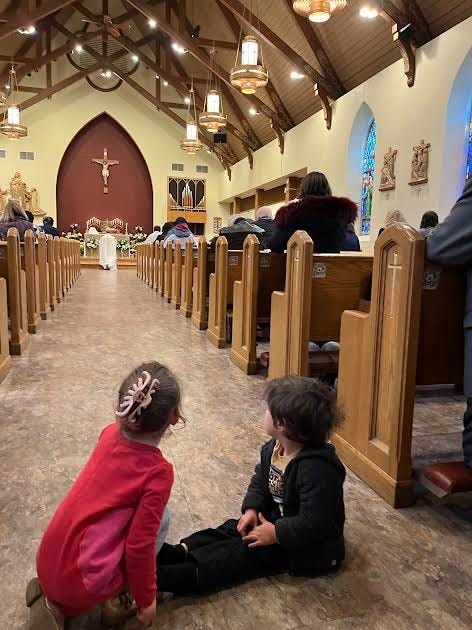
Photo courtesy of and property of the author
Though such moments were difficult, I was committed to Sunday Mass and thus willing to endure the challenges, including accusatory or belittling glares from our brothers and sisters in Christ who preferred a quieter Mass. Once after an especially onerous Mass with my young children, my non-Catholic brother asked me, “How was Mass?” Still feeling my cortisol levels high, I could only say, “Hey, Jesus was there in the Eucharist so that was good.” Indeed, we need to emphasize that regardless of our children’s behavior, attending Mass will always be worthwhile precisely because the value does not depend on our children’s behavior.
At various times, however, I had conversations with fellow parents who simply had opted out of Mass due to the difficulty of taking young children. Their explanations indicated the stress of the situation: “I don’t get anything out of the Mass with all the distraction.” “I just leave feeling angry with my kids.” “Everyone seems annoyed with us.” “It’s just too hard at this active age.” And finally, “The service is just too long to keep my children quiet.”
If we take seriously the importance of the Mass for Christian life, we need to consider such struggles of parents. Within the context of parish life, we can all be welcoming to families with young children and tolerant of the noise and chaos they may bring. An encouraging smile, rather than an obnoxious stare, can make all the difference for stressed Catholic parents making the heroic effort to get their young children to Mass.
However, the one easiest way a parish can be pro-family is simply this: a short homily. An experienced pastor once explained to me that five minutes (or less) was the optimal length for a homily. Such a length is brief enough to hold the attention of the faithful and allow them to remember one main point. Liturgically, the homily is important and ordinarily obligatory for a Sunday Mass, but it is not the equivalent of a Protestant sermon that might be the crux of the service. For Catholics, the homily rather points from the Scripture readings to the Eucharist, the Word made Flesh that comes to us body and blood, soul and divinity, in the Eucharist.
As a parent, I appreciated this prescription of a brief homily length because I so often found myself actively parenting through an extensive homily, not only unable to hear or to digest any of the content, but also fatigued by the effort of placating my children or surviving the exile in the back of the church with all the other hapless parents and frenetic children. In such cases, I found a similar pattern, which was that by the time of the Liturgy of the Eucharist – precisely in the midst of the Eucharistic prayer and consecration when I most wanted their peace and quiet – my children were absolutely unmanageable.
By contrast, with the pastor who kept his homily to five minutes or less, there was minimal struggle through the transition between the Liturgy of the Word and the Liturgy of the Eucharist, and my children were better able to focus and remain quieter during the Eucharistic prayer. While Jesus was present in the Eucharist at both the longer and shorter services, the experience was much more meaningful when the Mass was between 50 and 60 minutes; parents and kids alike were able to be more focused and end up less frustrated at the conclusion of Mass. We can see how parents attending a parish with brief homilies and services lasting less than an hour would be more likely to be consistent in their Mass attendance.
Of course, among the faithful are also many who do not have young children in attendance with them, and perhaps they could benefit from deeper, more extensive reflections on the Sunday Mass readings. Some parents, also, might appreciate the same. Fortunately, there are many who offer such lectionary commentaries, including this very Catholic Moral Theology Substack.
When it comes to Sunday Mass, however, a short homily may make all the difference for providing a welcoming environment for families that allows parents to be fully aware and actively engaged in the Mass, as is directed in Sacrosanctum Concilium:
But in order that the liturgy may be able to produce its full effects, it is necessary that the faithful come to it with proper dispositions, that their minds should be attuned to their voices, and that they should cooperate with divine grace lest they receive it in vain. Pastors of souls must therefore realize that, when the liturgy is celebrated, something more is required than the mere observation of the laws governing valid and licit celebration; it is their duty also to ensure that the faithful take part fully aware of what they are doing, actively engaged in the rite, and enriched by its effects (Sacrosanctum Concilium 11).
 | A guest post by
|