

Women's Historic Ecclesial Governance Roles & the Synod's Limitations
Editor’s Note: This post is a part of a series of responses to the special issue Women at the Synod on Synodality curated by Alessandro Rovati, the Associate Editor of the Journal of Moral Theology
Reading this timely and thoughtful special issue as a historian of Catholicism over the longue durée, I picked up on Catherine Clifford’s characterizations of both the Second Vatican Council and the Synod on Synodality as “historic” with respect to conversations they have opened, and some structural changes they have engendered, respecting women’s participation in high levels of ecclesial deliberation and decision-making. Although I am not an activist pushing for specific roles for women in today’s Church, I also find myself agreeing with Clifford and other contributors to this volume who believe that the Synod, with its inclusion of women as full voting members, represents important but only modest change from earlier, pre-conciliar norms in this area.
However, I differ on the whole with the contributors to the special issue in that I do not believe Vatican II itself was a great conceptual watershed where women’s participation in Church governance is concerned. Indeed, I propose that Catholic scholarly conversations broadly related to this topic should become grounded in greater attention to the more than fifteen centuries of often robust exercise of power within and over the Church—power that was, furthermore, regularly supported by papal judgments and other authoritative instruments of ecclesial law.
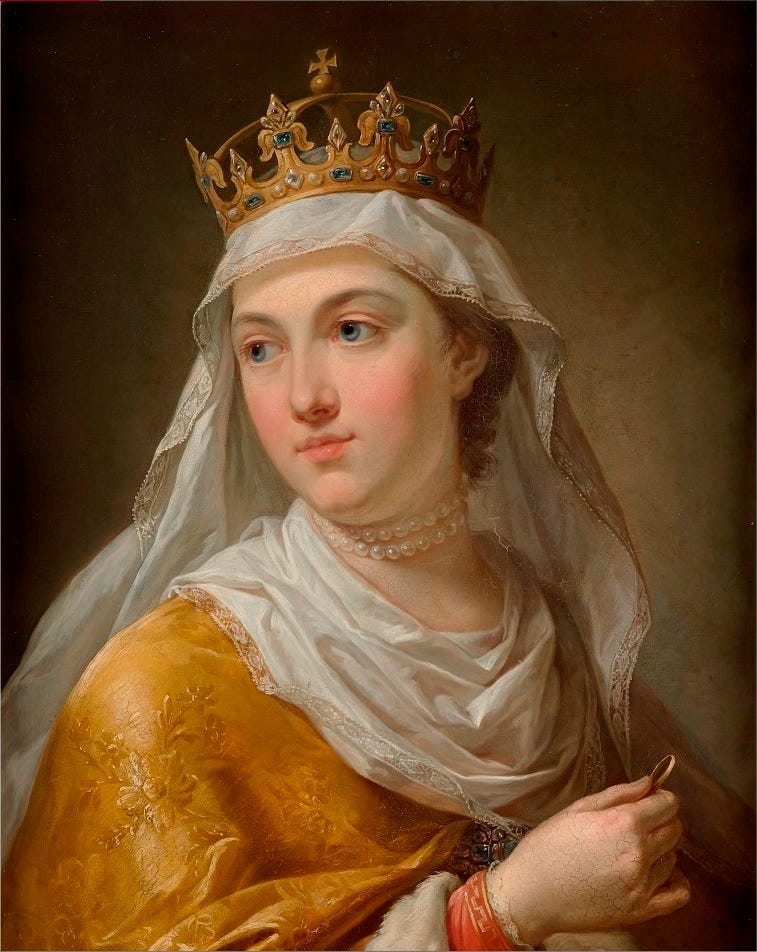
For example, from the late Roman era through the eighteenth century, Christian empresses, queens regnant, regents, and many other politically and socially powerful women directed high-level ecclesial affairs often with explicit affirmation from popes and other ranking churchmen. Empress St. Pulcheria participated in the Council of Chalcedon and was thanked profusely by Pope St. Leo the Great for employing her God-given power to discipline Nestorian and Eutychian heretics—some of them bishops. Empress Irene of Athens, with the blessings of Pope Adrian I, who stayed home in Rome, and while standing alongside a Patriarch of Constantinople whom she had selected for priestly ordination and then appointed to his high office, convoked and gave legal force to the Second Council of Nicaea. Poland’s late-medieval monarch, St. Jadwiga, chose bishops and established the Diocese of Vilnius—actions that were ratified by Rome after the fact. Queen Isabella of Castile appointed numerous bishops with authorization from three successive popes. Archduchess Isabel Clara Eugenia, Governor of the Habsburg Netherlands, ensured that the norms of the Council of Trent were implemented by the bishops in her domains and protected Jesuits, Capuchins, and other new orders critical to the success of the Catholic Reformation. Closer to our own time, Empress Maria Theresa of Austria lawfully appointed bishops, regulated seminary curricula, regulated and at times suppressed religious congregations, and determined which feast days would be celebrated in various dioceses—all of this while recognized formally by Rome as Regina Apostolica, a title of great ecclesiastical stature.
Such examples of ecclesially powerful, not just secularly powerful, ruling women of Christendom abound in the records of the Church’s past. We find them across diverse epochs, geographies, and social and political contexts of the Church’s development. Yet this category of leaderly women, despite numbering saints and blesseds among them, is entirely absent from the list of leaderly women of the Church’s past that was presented to us by Vatican officials in the Synod’s Study Group 5 report on women’s participation in the life and leadership of the Church that appeared this past March.
Although synodal discussions have been relatively more attentive to the legacy of territorial abbesses of past times, the Study Group 5 report and various other synodal documents and surrounding conversations misleadingly characterize their power as de facto, not de jure. Yet for centuries, not just in earlier medieval times as is sometimes asserted, certain women consecrated as abbesses had quasi-episcopal jurisdiction over both male and female religious communities and, in some cases, over parish churches. Furthermore, they were typically affirmed in this authority by a mix of papal judgments, affirmations by other leading churchmen, and decisions by sacrally-anointed lay rulers such as the Holy Roman Emperor and the King of France. In medieval and early modern times, abbesses in Germany, Italy, France, Spain, and other lands safeguarded their rights of governance against efforts by bishops to usurp them. These rights, often acknowledged in binding papal decrees and ecclesiastical court rulings, at times included participating actively in local ecclesiastical synods, convoking some synods, holding ecclesiastical courts of their own, choosing men who would be ordained, and disciplining wayward clergymen—even to the point of dismissal from curacies and other pastoral benefices.
Ironically, while the synodal Study Group 5 report reduced all of this to “de facto authority,” it was precisely the opposite—abbesses’ de jure authority on the books, but no longer always de facto or actually exercised ecclesial power—that survived the longest into the nineteenth century. Maria Kunigunde of Saxony, as Princess-Abbess of Essen and Thorn, possessed formal rights to sit alongside bishops in synods and to appoint and discipline parish clergymen in her domains specifically as a Princess-Abbess of the Church, not just as a Princess-Abbess of the Holy Roman Empire. She was furthermore recognized in that ecclesiastical dignity and rank by the Pope, in the same way that various Princes of the Church remained recognized as such by Rome even after losing their traditional secular political power, once the revolutionary secularization of her domains by Prussian troops allied with Napoleon was accomplished in 1802.
More striking still, María del Pilar Ugarte y Cortés, the last Abbess of the famous royal monastery at Las Huelgas in Spain, was recognized formally in Rome as a “regular prelate” of the Church, with jurisdictional rights in her domains equal to those of bishops (“secular prelates”) in theirs. Her domains remained independent of any diocese until 1874. These de jure rights were suppressed long after Spain’s bishops had ensured they were no longer exercised in practice. That was during the Bourbon era in Spain when the bishops—as was true in the Holy Roman Empire, France, and other regimes in the eighteenth century—had collaborated with royal authorities to suppress in fact if not always yet in law many ancient monastic privileges as well as ecclesial governance privileges long affirmed by popes, councils, ecclesiastical courts, and royal courts on behalf of a variety of non-episcopal and even non-clerical actors.
Considering the fifteen-century-long tapestry of such neglected yet well-established facts of Church history where women’s steady, if circumscribed and politically embodied, participation in ecclesial governance is concerned, I struggle to see what was so historic, after all, about the inclusion of several handpicked women as listening-only attendees of the Second Vatican Council. I also struggle to see what is progressive, let alone radical, about allowing larger groups of episcopally-vetted women to serve as voting members in a synodal process that, despite its grass-roots elements, has been from its beginning to its present moment highly orchestrated by ranking clerical authorities. Finally, I struggle to see what is radical, let alone a threat—as some conservative Catholic voices characterize it—to the supposedly deeply traditional governing rights of the clergy per se within and over the Church, in Pope Francis’ and Pope Leo XIV’s recent appointments of women to positions in a curial bureaucracy over which the Pope is, of course, the supreme authority.
In short, I agree with the contributors to the special issue that the recently commenced synodal conversations about women, ecclesial leadership, and especially ecclesial governance are a modest beginning of something. I see that something, however, not as a fulfillment of a vision first articulated or gestured at in a serious way in the 1960s, but rather as a recovery of a much deeper, multifaceted, and deeply Catholic tradition of both lay and women’s ecclesial governance that has been with us for generations but neglected in dusty, dark corners of the Church’s attic, so to speak. Because of its associations with historical political and social structures that Catholics of the last century or so have been taught to view as illiberal, overly patriarchal museum pieces, it is tempting to continue neglecting it. Thankfully, however, the recent Synod on Synodality, despite its documents’ limitations in this area, is prompting a great deal of fresh ecclesiological thinking and open-minded revisiting of the Church’s long and rich experience in many temporal as well as global contexts. I am therefore confident that the numerous ecclesially governing women of the Church’s deeper past—saints, blesseds, and otherwise—will be ever more welcome at the table as our synodal conversations continue.
Editor’s Note: For more conversations with the Journal of Moral Theology’s authors and responses to their essays, check out HERE.
 | A guest post by
|