

The Catechism, Just War, and Prudential Judgment
What "Catholic morality" really means
· “Yeah, there is one thing. My own morality. My own mind. It’s the only thing that can stop me…. I don’t need international law.” – Donald J. Trump, January 7, 2026
· “You know that to the winner belong the spoils. Go for the spoils. I’ve said why don’t we use it to the victor go the spoils.” – Donald J. Trump, April 6, 2026
· “[Y]ou can talk all you want about international niceties and everything else. But we live in a world, in the real world … that is governed by strength, that is governed by force, that is governed by power.” – Steven Miller, January 5, 2026
· “We’re going to go on the offence, not just on defense. Maximum lethality, not tepid legality.” – Pete Hegseth, September 5, 2025
· “We fight to win. We unleash overwhelming and punishing violence on the enemy. We also don’t fight with stupid rules of engagement. We untie the hands of our warfighters to intimidate, demoralize, hunt and kill the enemies of our country. No more politically correct and overbearing rules of engagement, just common sense, maximum lethality and authority for warfighters.” – Pete Hegseth, September 30, 2025
· “Let every round find its mark against the enemies of righteousness and our great nation. Give them wisdom in every decision, endurance for the trial ahead, unbreakable unity, and overwhelming violence of action against those who deserve no mercy.” – Pete Hegseth, March 25, 2026
These quotes reflect a significant – and dangerous – shift concerning the use of armed force during President Donald J. Trump’s second term in office. During his first term, Georgetown law professor Rosa Brooks wrote that “in contrast to Bush, Trump makes no secret of his disdain for the laws of war.” In her judgment, “Bush at least tried to cloak his administration’s use of torture in legal sophistry, a backhanded testament to the strength of the norms his aides sought to circumvent.”
As for his current term, in a new book, Killing Machines: Trump, the Law of War, and the Future of Military Impunity, Thomas Gift argues “that Trump is unique among US presidents in the extent of his willingness to discard the law of war.”
Indeed, the approach to armed force that is reflected in the above quotes from President Trump, White House deputy chief of staff for policy and homeland security Stephen Miller, and Defense Secretary (or as he calls himself, “Secretary of War”), Pete Hegseth is a hybrid of might-makes-right realism, a hypermasculine warrior ethos, and holy war. None of the above quotes are consonant with the Catholic moral tradition and just war theory, which influenced what we now refer to as the laws of war and the rules of engagement.
To his credit, Vice President JD Vance, who has a book about his conversion to Catholicism due out this summer, brought up the “more than 1,000-year tradition of just war theory,” but he did so to question a remark by Pope Leo IVX that “God is never on the side of people who wield the sword.” Vance offers his advice: “If you’re going to opine on matters of theology, you’ve got to be careful. You’ve got to make sure it’s anchored in the truth and that’s one of the things I try to do and it’s certainly something I would expect from the clergy.”
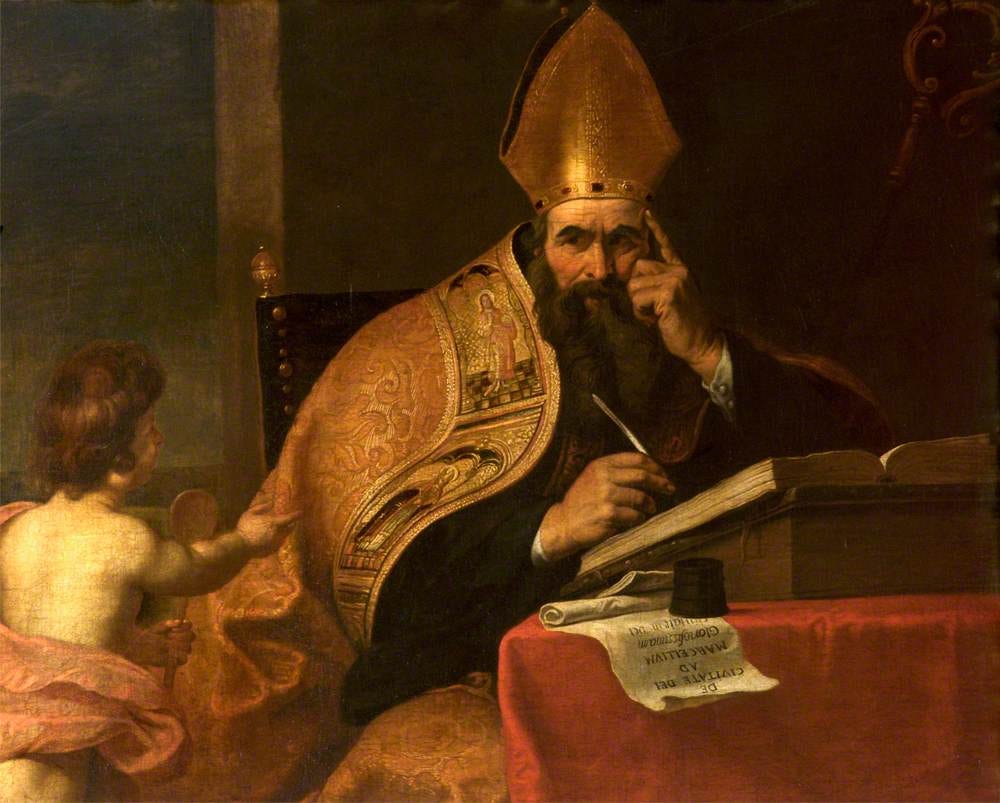
Attributed to Gerard Seghers - http://www.nationaltrustcollections.org.uk/object/1257059, Public Domain, https://commons.wikimedia.org/w/index.php?curid=43661956
To be fair, in his Palm Sunday homily, the pope specifically spoke of Jesus: “Jesus is the King of Peace, who rejects war, whom no one can use to justify war. He does not listen to the prayers of those who wage war, but rejects them.” On this point, Pope Leo appears to have in mind Christians, such as Hegseth, a member of a church affiliated with the Congregation of Reformed Evangelical Churches, founded by Doug Wilson, who self-identifies as a Christian nationalist. The conservative evangelical Christians, with their biblical fundamentalism, hold an apocalyptic worldview that includes holy war. Although the Catholic Church, going back to Pope Urban II’s call for the First Crusade in 1095, has held such an approach in the past, it now teaches that, as the US bishops put it in their 1983 pastoral letter, The Challenge of Peace, “a crusade mentality” is no longer legitimate, and “no state should act on the basis that it has ‘absolute justice’ on its side” (#93). As Darius von Güttner-Sporzyński notes, “Where just war limits violence, holy war sacralises it. War is no longer a tragic necessity, but an act aligned with divine will.”
In an apparent response to Vance, Bishop James Massa, chairman of the US Conference of Catholic Bishops’ Committee on Doctrine, clarified that “for over a thousand years, the Catholic Church has taught just war theory and it is that long tradition the Holy Father carefully references in his comments on war.” In this connection, Bishop Massa refers to the Catechism of the Catholic Church, #2308, which – quoting from Vatican II’s Gaudium et Spes, #79 – states that “governments cannot be denied the right of lawful self-defense, once all peace efforts have failed.” Bishop Massa adds, “That is, to be a just war it must be a defense against another who actively wages war, which is what the Holy Father actually said: ‘He does not listen to the prayers of those who wage war.’” In other words, Pope Leo was referring to aggressors who unjustly choose to embark on war.
According to the Catechism, #2309: “The strict conditions for legitimate defense by military force require rigorous consideration,” and “the gravity of such a decision makes it subject to rigorous conditions of moral legitimacy.” The Catechism notes that these criteria are “the traditional elements enumerated in what is called the ‘just war’ doctrine.” Although the number of criteria vary from source to source from St. Augustine to the present, the Catechism highlights four:
1) the damage inflicted by the aggressor on the nation or community of nations must be lasting, grave, and certain
2) all other means of putting an end to it must have been shown to be impractical or ineffective;
3) there must be serious prospects of success;
4) the use of arms must not produce evils and disorders graver than the evil to be eliminated.
In contrast to all the quotes at the beginning, according to the Catechism, “The Church and human reason both assert the permanent validity of the moral law during armed conflict” (#2312). Moreover, “Actions deliberately contrary to the law of nations and to its universal principles are crimes, as are the orders that command such actions.” In this connection, the Catechism states, “Thus the extermination of a people, nation, or ethnic minority must be condemned as a mortal sin” (#2313).
For Vance, “We can, of course, have disagreements about whether this or that conflict is just.” And this is true, we can, but should we? Especially after “rigorous consideration” as the Catechism put it? True, the Catechism notes, “The evaluation of these conditions for moral legitimacy belongs to the prudential judgment of those who have responsibility for the common good” (#2309).
As William T. Cavanaugh wrote in a 2003 article, originally published in Commonweal magazine, in response to those who questioned whether Pope John Paul II and the bishops “had overstepped their competence” in judging that the war against Iraq was unjustified on just war grounds, this line from the Catechism has been incorrectly interpreted to mean “that we should hand over responsibility for judging the justice of war to the president on the basis of his superior access to information.” For Cavanaugh, while the Catechism “lays an obligation on civil authorities to consider moral truth, and not merely reasons of state, in deciding issues of lethal force,” it also “nowhere limits the church’s own competence in these matters.”
Furthermore, Cavanaugh homes in on “prudential judgment” as a reminder that “information is secondary to moral formation in the making of moral judgments.” For Catholics, just war theory is more than a checklist of criteria or a tool of statecraft. Just war requires virtues such as justice, prudence, fortitude, and temperance -- and even mercy. Accordingly, I agree with Bishop Massa: “When Pope Leo XIV speaks as supreme pastor of the universal Church, he is not merely offering opinions on theology, he is preaching the Gospel and exercising his ministry as the Vicar of Christ.”
 | A guest post by
|