

Pentecost Sunday
The Harvest of Pentecost
Find this week’s readings here…
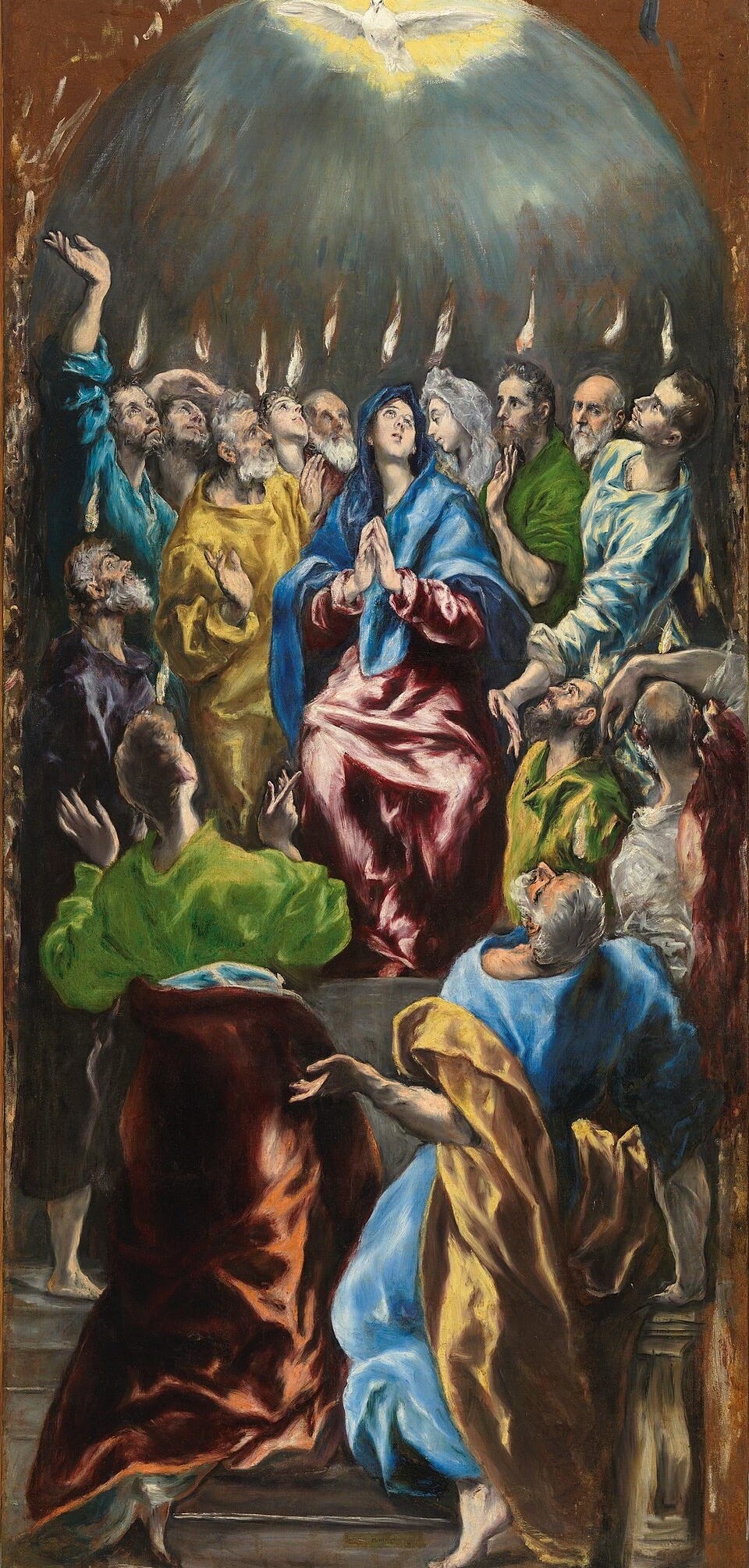
This Sunday we celebrate Pentecost, which comes fifty days after Easter. Pentecost originated as a harvest festival called Shavuot, during which loaves of bread from the spring wheat harvest were dedicated to God as an offering of first fruits (Lev. 23:15-17). Over time, the festival also came to commemorate another harvest of God’s gracious action in the world: the giving of the Torah to Moses at Sinai and the formation of Israel as a people (Exod. 19-20).
The Christian feast of Pentecost continues this story. It gathers these earlier harvests of divine grace and situates them in relationship to another: the gift of God’s own life in the Holy Spirit. This gift inaugurates a new “harvest,” one that brings together peoples from every land, language, and culture into Christ’s ecclesial body on earth, the church.
In what follows, I want to consider more closely the significance of Pentecost as a kind of harvest. What is gathered and bound together here is not grain from the fields but a people – a people with a particular shape. What, then, is this people, and what is its shape?
At the beginning of our first reading from Acts, we learn that the disciples were together when the Holy Spirit appeared “like a strong driving wind,” filling the house, and then as tongues of fire resting upon them (Acts 2:2-3). Yet the manifestation of the Spirit’s work on which the reading mainly focuses is linguistic. Once filled with the Spirit, those gathered “began to speak in different tongues,” and the pilgrims present in Jerusalem for the festival each heard them in their own native language (Acts 2:4-11). For Christians in America hearing this text during a time marked by war and geopolitical hostility, one detail is especially striking: among those gathered were Parthians, Medes, and Elamites (Acts 2:9) – peoples from regions that are now part of modern Iran.
Notice that those gathered were not all speaking a single common language – not Aramaic, not Greek, nor some official language that erased difference through uniform speech. The vision here is not the nationalist dream of everyone learning the same language. The disciples speak in the languages of the visitors themselves, which the text mentions explicitly four times (vv. 4, 6, 8, 11). The implication is clear. Whether proclaimed in Jerusalem or elsewhere, the Gospel gathers a people not by abandoning or erasing diversity and particularity but by embracing them, meeting people with the words that have formed them and that are distinctively theirs.
At the same time, Pentecost clearly destabilizes widespread assumptions about what it means to be a people. We live moment marked by nationalisms – even Christian ones – which draw strong ethno-racial boundaries around national identity and belonging. To be clear, the coming of the Holy Spirit at Pentecost does not erase the languages we speak, the histories and cultures that shape us, or the nations to which we belong. But the Holy Spirit does profoundly relativize those attachments in relation to a deeper one: to Christ and to the kind of neighbor love revealed in him.
One of the characteristic marks of this attachment, and the new people it brings into being, is that belonging is no longer fundamentally a matter of my people, my language, or my culture considered in isolation, but of how they are related to the whole community of the human. The disciples, after all, are entrusted with a message for all peoples and nations, and they are sent by God to share it. As we heard in the readings for Ascension Sunday, Jesus promises the disciples that they will receive the Holy Spirit, and that they “will be my witnesses … to the ends of the earth” (Acts 1:8; Mt 28:19-20). Pentecost is a decisive moment in this story: a foretaste – the first fruits – of a future harvest gathered from “a great multitude that no one could count, from every nation, from all tribes and peoples and languages, standing before the throne and before the Lamb” (Rev. 7:9).
In light of Pentecost, the most important thing about the church is not its teachings or message, essential though these are. The most important thing about the church is simply that it exists, that it is a people that gathers diverse peoples into a new people in whom ordinary divisions have been overcome. It is a people of peoples in whom, as our second reading from 1 Corinthians makes clear, there are many gifts, all animated by the same Spirit and ordered toward a common good (1 Cor. 12:3-7, 12-13). In Christ and through the work of the Holy Spirit, a deeper unity has become possible and perceptible in the world.
Once, while helping teach a week-long intensive theology course with seminarians from across Central America, I heard a preacher remind those of us gathered that whatever country we came from – the United States, Guatemala, El Salvador, Honduras, Panama, or Puerto Rico – our shared life in Jesus Christ is more fundamental than any claim of nationality. It is not that those national identities disappear or become meaningless, he said, but that in Christ, and in the body that is the church, they are no longer ultimate.
I have thought about his words often over the years, realizing that everywhere I have known the church, I have witnessed this deeper unity. Whether in the Polish nuns and American priests with whom I grew up in Zambia, or in the Spanish priests and American nuns who worked and even shed their blood for the Salvadoran people, or in the Philippine, Nigerian, and Colombian priests of my local parishes in the US, the church has manifested itself as a border-crossing people, consisting of members who say, in the words of Ruth to Naomi, “your people shall be my people” (Ruth 1:16).
Even for those who never undertake such journeys, a border-crossing love marks this people and gives shape to its distinctive way of being a people. The parable of the Good Samaritan is exemplary, with the Samaritan becoming neighbor to the wounded man not simply because he left his path to care for him, but because his compassion crossed and overcame the divisions separating Samaritans and Jews. And as in our Gospel reading from John, even the seemingly insurmountable boundaries created by sin can be forgiven and overcome through the gift of the Holy Spirit Jesus breathes onto his disciples (Jn. 20:19–23).
All this is a way of being a people that Pentecost has made possible, a gift the Holy Spirit continues to offer to a world marked by division. For Pentecost remains the sign – despite all evidence to the contrary – that division is not the final word over human life.
 | A guest post by
|