

Let a Thousand Weeds Bloom? (16th Sunday OT)
Why We Need to Look Again at the Parable
What happened when you don’t weed a garden? That’s an easy question: the weeds eventually overrun the garden. Any farmer knows this. I once attended a Sierra Club presentation by a local farmer who showed many slides of her beautiful, diversified land, with preserved portions of woods; one showed a deer emerging from the woods. An audience member asked what she did about the deer, and the farmer smiled and said, “You’re not gonna like the answer.” Sometimes the deer have to be dealt with. And so it goes in many areas of life: when you don’t clean the bathroom, mold will grow. When you don’t deal with opportunistic criminals, communities decay. When you don’t deal with corrupt government officials, the whole enterprise is imperiled. When you don’t deal with a particularly disruptive student, the whole classroom is affected. When one company breaks rules and regulations, all their competitors are harmed. When a few athletes throw games for gamblers, the whole sport suffers. When you let off sexual predators easy, the whole church is endangered.
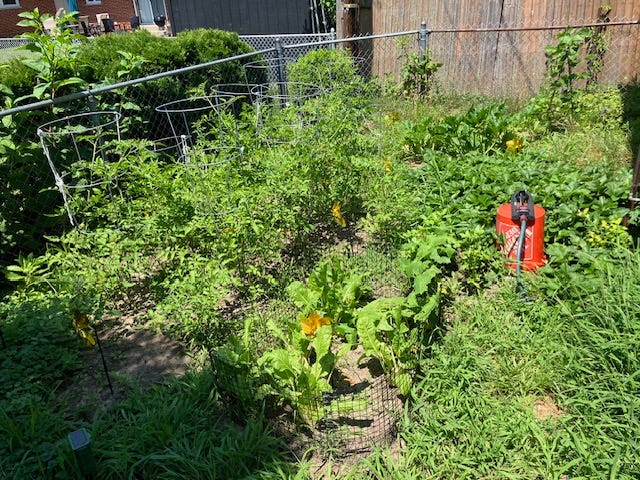
Picture: The Moschella/Cloutier garden, as of July 13th
It’s in fact typical that Jesus’ parables have a pretty sharp edge to them. Sometimes, these edges are challenging, but not in a way that defies logic. The prodigal son story may seem to create some “moral hazard” problems, especially in a family-centric society, but placed within the context in which the parable is actually offered - the gathering of sinners and tax collectors around Jesus, rather than the Pharisees - we can see the logic of the story. Besides, the younger son does have to return and acknowledge his terrible actions, and the older son is assured that he is still the heir! Similarly, the Good Samaritan story is offered as a response to the rabbinic question, “who is my neighbor?”, and it clearly suggests the answer is the one whom we meet who is really in need of help. This is a lesson that we certainly don’t always practice, but plenty of parents routinely do this in paying attention to their children, and in reality, many of us are apt to come to the aid of our neighbors, even strangers, who’ve suffered a disaster. Our scope is often not broad enough, to be sure. But the parable’s logic does fit reality, insofar as we recognize the great benefits of a society where we come to the aid of those in trouble, regardless of other considerations.
But this wheat and tares thing just seems… wrong. That’s not how reality seems to work on any level. Perhaps this is a matter of exactly what Jesus states in last week’s gospel, that those of us who do not understand are blind to the reality of the Kingdom! We must take that aspect seriously; at the same time, “taking it seriously” cannot mean, for example, we cease weeding our gardens or punishing corrupt clergy.
The Church’s choice for the first reading, from the book of Wisdom, helps. In this reading, the initial stress is laid on God’s total “mastery over all things,” which is interestingly linked to God’s being “lenient to all.” God’s just judgments and God’s mercy are not somehow two sides of a split personality, but rather go together. This is ultimately because, unlike the world, there are no real opposing powers to God’s sovereignty over the universe. “The enemy” in Jesus’s parable can secretly sow weeds of real discord, but that enemy has no power over the harvest. There is a sense in which the wheat growing in the world cannot ultimately be killed or overrun by the weeds, because the master of the harvest will come.
Thus, if we are seeking the logic of this parable, we can hazard three claims that might make sense. First, as the first reading concludes, “you gave your children good ground for hope that you would permit repentance for their sins.” As Francis exclaims near the end of Amoris Laetitia, “No one is condemned forever!” And of course this reading must acknowledge the basic truth that, to some extent, we are all weeds. The parable indicates that the Kingdom “permits repentance” - a recognition that, it must also be acknowledged, is not well-suited to the core metaphor, which tempts us to think about the world simply in terms of good people and bad people. If we are tempted in this way, we should certainly then imagine that we are one of the tares!
Second, as befits this acknowledgment of our own sinfulness and our solidarity in sin, the first reading insists that “those who are just must be kind.” To exercise real power is to combine justice and kindness in a way that can be extremely challenging - but nevertheless, we also can recognize from our own experience. In this case, the “kindness” appears to be the gentleness and encouragement that parents ideally show to their children when they err, but that we can also recognize over and over in the way people deal with conflict and discord in any area of life. Fairness can’t go out the window in such situations - indeed, that can end up not being “kind” to a weed, but (to mix our parables) be a matter of not pruning a vine that could grow much better. To fail to leaven justice with kindness is, in some sense, to be very un-god-like and to betray an anxiety about one’s power. (As an aside, I think Leo XIV is particularly good at this combination!)
Thirdly, I think it must be admitted that here we have a parable which only makes sense in light of an eschatology that really believes the credal statement that Christ will come again “to judge the living and the dead.” This is at root the confidence expressed in the first reading’s assurance that God has “mastery over all things.” If you think the weeds will really overrun the garden - meaning the God’s kingdom will fail if you don’t go in and pull up the weeds - you lack confidence in the parable’s image of the harvest separation, after which “the righteous will shine like the sun in the kingdom of their Father.”
In practice, this third point points to what might be called the “liminal nonviolence” of God’s Kingdom, a nonviolence that ultimately relies on the weapon of the Cross rather than the means of worldly force and violence to achieve its end. I call it “liminal” because, as the initial examples suggest, I don’t think the story excludes forms of correction and judgment. To go after some of the weeds while being careful to preserve the wheat, you might say, is not excluded - although what that means is illustrated in the first two claims so clearly highlighted in the first reading. No scorched-earth weeding! After all, haven’t we learned that a house can be “too clean”? Still, I don’t want to get too close to taking the edge off the parable, an edge that cuts most clearly (including against each one of us) when we recognize that the world lives toward a time when all will receive judgment, and all the weeds of our own lives will have to go off to the furnace. In light of this, we may rejoice that God’s power allows for great mercy, and so seek to show that mercy to others, as the Lord’s Prayer commands. In the meantime, we might also then learn to live well in a world (and a Church!) where we curb our tendencies toward overzealous weeding.