

Getting Human Flourishing Right
It's not about results, but about rational activity itself
At a recent conference on AI and the virtues, a philosophy graduate student from University of Aberdeen gave a really interesting paper about the sloppy omnipresence of the word “flourishing” in discussions about AI. She was rightly concerned that the actual content of the term was not only sloppy, but tended to be filled by a results-based framework; flourishing involved producing certain outcomes. Like an earlier paper that noted with concern the use of AI chatbots as a treatment for the “epidemic of loneliness”, the paper was nuanced: of course there are outcomes we want in a flourishing life, just as we do want to recognize the real problem of loneliness that might be allieviated by interactions with AI. But there was also significant loss. The loneliness paper said the fundamental error was treating loneliness on a medicalized, disease model. And the flourishing paper likewise followed out intuition that we can’t measure flourishing the way we measure factory outputs.
The paper made me think about a key lesson in my ethics class, one that gets almost no bandwidth in usual discussions, and is tricky to teach, because it’s abstract. This is the fundamental idea, in the first book of Aristotle’s Nicomachean Ethics, that human flourishing is “rational activity.”
Both words cause confusion, but are vitally important. “Activity” is not just a means to flourishing; it IS flourishing. And “rational” doesn’t mean high-grade academic activity; it means, as I say to students, that “you know what you are doing.” There are various ways to make these teachings clear. On the importance of activity, Nozick’s thought experiment about “the experience machine” becomes ever more relevant. And on the importance of rational, it becomes pretty easy to point out that we rely all the time on the fact that people “know what they are doing” and that it is a pretty universal experience to try to escape if one finds oneself in a situation where you don’t know what you are doing.
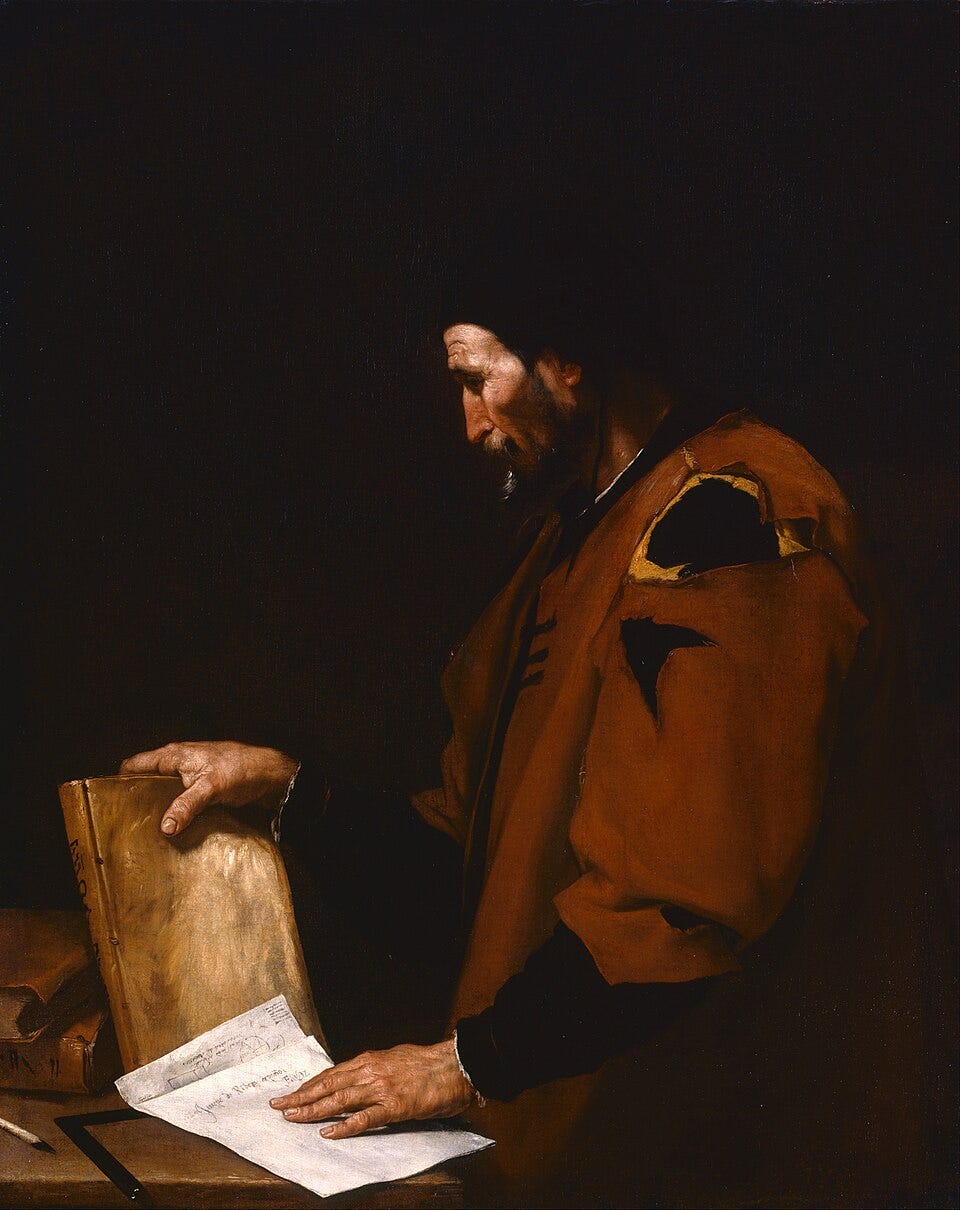
Ribera, Jusepe de - Aristotle; from https://en.wikipedia.org/wiki/Aristotle_(Ribera)#/media/File:Ribera,_Jusepe_de_-_Aristotle_-_Google_Art_Project.jpg
While many (rightly) speak about the recovery of virtue ethics in AI, and many (including our Holy Father!) speak eloquently about the tremendous dignity of the human person, both ideas really point to this central nexus of rational activity. The virtues are simply the characteristics that we need to be excellent at rational activity, to do it readily, to cooperate well with others, to avoid being blocked by fantasies or fatigue. And the magnificence of the human person involves the work of reason and, as arguably the most important “activity” we do, relationships of voluntary commitment (don’t worry I will say something about love and God later…)
Even the latter point, about relationships, can get lost in Aristotle’s “rational activity,” but that’s not even true for Aristotle. He believes (at some points) that the best and highest form of rational activity is clearly relational (politics), and (not unrelatedly) spends significant time lauding friendship as the most important of activities. If we extend this to recognize (as Aristotle did not) the importance of family relationships and the dignity of craft labor, we will certainly see that speaking about rational activity is not somehow a distraction from being made for human relationships, but among the most (if not the most) important such activity. But we also seem to miss how important it is to understand relationships as a rational activity - again probably misled by our equation of activity with “project” and rational with “stuck in your head.” What we mean is relationships where everyone acts well and knows what they are doing.
Let me just say why getting this point matters so much, and then respond to an objection. First, this matters so much because this is really the key to getting AI right. AI’s promise and danger are the same thing: instant results, without a great deal of activity. Unless we go rabidly anti-tool (i.e. much more anti-tool than the Amish), we need to recognize that labor-saving activity is not only not going away, but we all want it and use it over and over (running water, anyone?? Hugely labor-saving!). So we can’t just say, “AI just gives you the result of a paper” and presume everyone will see that the point of writing a paper is writing the paper. We need to name why rational activity is important, and (more pointedly) why THIS PARTICULAR FORM of rational activity is essential for flourishing. In Magnifica Humanitas, Pope Leo reiterates the fundamental meaning of work, not simply as a means:
work is not simply an instrument; it expresses and enhances the dignity of our lives. It is a requirement of the human condition, a normal path toward maturity, development and personal fulfilment. In this regard, financial assistance to the poor may at times be necessary in emergencies, but it cannot become the sole response, since the goal is to enable each person to live with dignity through his or her own work. (#149)
Yet AI will change work, and we need to be more intentional about those changes. Nicholas Ogle, in a post from last week, nicely explains why AI necessitates choices about “selective de-skilling.” To use a more earthy example: my wife’s family is Italian, and they all know how to cook; they own microwaves, but they would not think highly of someone who just want “the results” and didn’t know something about “how to cook a meal.” Maybe everyone doesn’t need to know how to cook (although maybe not!). But does everyone need to know how to read in a sustained, focused way? Mass literacy is an extraordinary social achievement, but does the advent of AI mean we now don’t have to know how to read (=cook) in order to get the “result” of knowledge (=meal)? The same is true about writing, but overall, AI should prompt us to gain much more clarity about what is actually worthwhile and central activity in human lives. A colleague in moral theology, Nichole Flores, said casually in a conversation, “I just want to go running, do baking, and go to mass… with my kids.” There’s a nice statement of flourishing, though as with any example, it raises lots of questions about how all the other work we do rely on for our lives gets done! But as something that points us back to basics - what is truly worthwhile rational activity - it is provocative and instructive.
Now to the objection: doesn’t this emphasis on worthwhile rational activity privilege certain groups of people? Isn’t it “ableist”? Let’s go back to that going to Mass bit: there is certainly a way in which Aristotle’s account of flourishing has to be somewhat revised in light of the Gospel, and God’s activity (although grace builds on nature!). At this point, I might have referenced a now-disgraced Catholic who worked with the mentally ill, but the generic lesson stands well enough on the authority of many saints: we learn we are not ultimately in charge best by recognizing and relating to those who are not necessarily “succeeding” by Aristotle’s standards. Such compassion is ultimately learned only when we do not turn this service into an activity at which we can be excellent, but one that teaches us our own lack of excellence, our weakness, our own sin, our own being sustained by God’s gracious excessiveness, especially the excessiveness of Christ. As Leo writes:
It is precisely within our limitations that the following find a place: compassion, as well as a sincere concern for the needs of others; a generosity that can emerge even in the midst of darkness and failure; spiritual experience and the worship of God. We see this at many moments when our limits become tangible: when we face rejection, when we suffer the illness or loss of a loved one, when we encounter our own weakness or failure. Mysteriously, it is precisely in such moments that we can discover a new wisdom, tangibly experience the closeness of others and encounter the presence of the Lord. (#119)
This is because our own rational activity, while good, is dependent on and oriented toward something greater. Near the conclusion of the core chapter of his encyclical, Leo offers a wonderful description of this:
The expression “more than human” is not an exclusive domain of technological promise. For centuries, the Christian tradition has maintained that human beings are not confined by the boundaries of their own nature; rather, they are called to self-transcendence, not through an escape from reality or a contempt for their limitations, but through their fulfillment in love. Faith recognizes an openness toward the “beyond,” which originates as a gift from God. …The one who makes this passage possible can only be the Eternal One who gives of himself. Indeed, it is God himself who overcomes the “infinite” disproportion. …When we embrace the possibility of transcending ourselves through God’s grace, we do not deny our nature, nor do we become less human. …Herein lies the radical departure from Promethean dreams: what saves humanity is not enhanced self-sufficiency, but a relationship that liberates, a communion that transforms. … A person’s future is not calculable, but depends on one’s freedom — elevated by the inexhaustible grace of God — and on the relationships cultivated. (#127-128)
As Gaudium et Spes and John Paul both taught, the human person is ultimately fulfilled by free self-gift. This is something that is possible only by receiving, by worshipping… but even then, it is part of the gift that we are able to “know what we are doing” when we do this most worthwhile of all human activities.