

Fourth Sunday of Easter
The Shepherd's Abundant Life
At the heart of our readings for this Sunday is the image of God as a shepherd, which is one of the earliest and most enduring ways Christians have described the person and work of Christ.
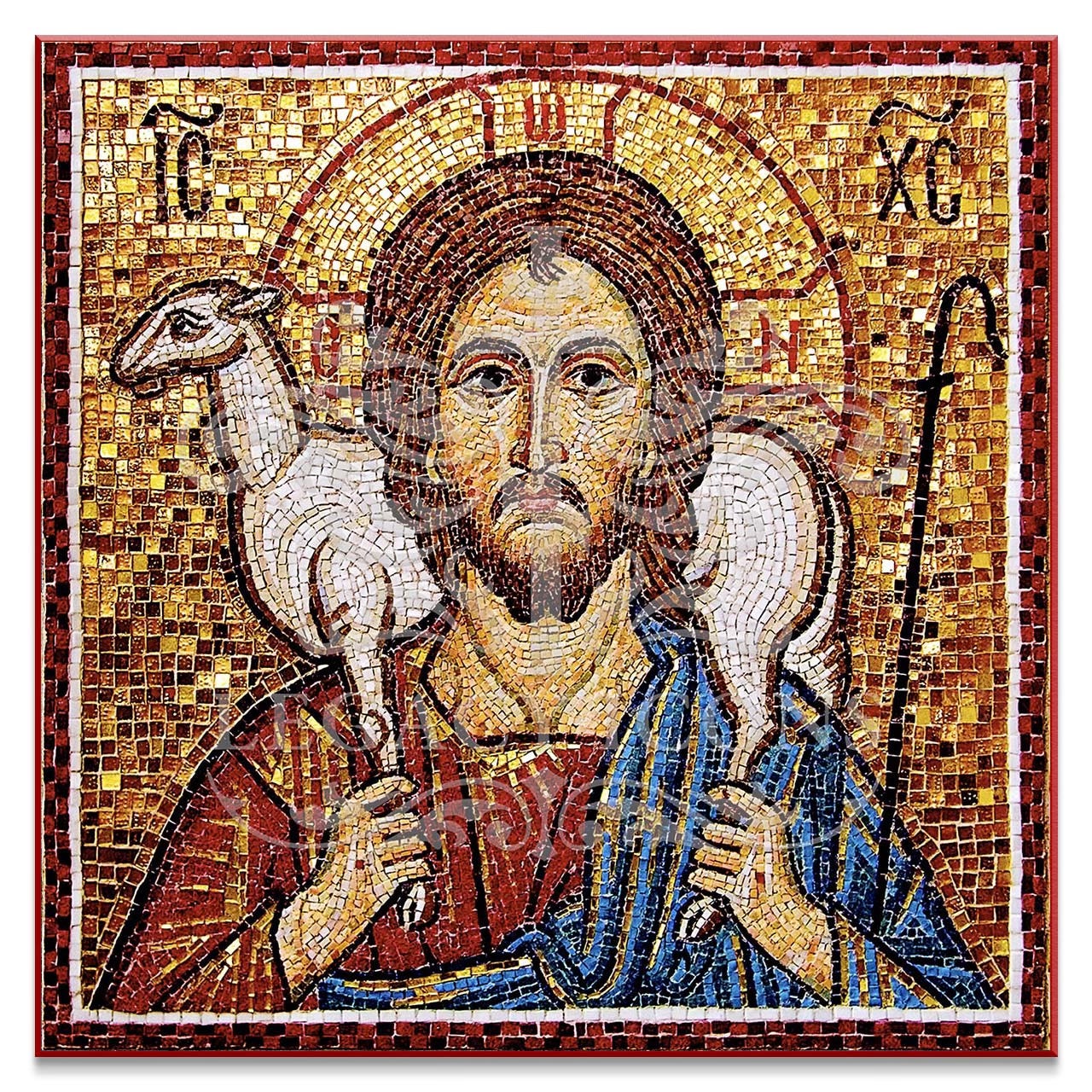
We encounter it in our psalm for this week, Psalm 23, in which the Lord is the shepherd, even amid“the darkest valley” (Ps 23:4). In our second reading, 1 Pt 2:20-25, Peter reflects on the passion of Christ, especially how it serves not only as an example for us to follow but also as a source of grace that comes to our aid in times of need and enables us to return to the shepherd and guardian of our souls. And finally, there is Jesus’s identification of himself as the Good Shepherd – one of central images of Jesus in John’s Gospel – an identification that draws deeply on Israel’s scriptures, including Psalm 23.
Interestingly, our Gospel reading begins not with the image of the Good Shepherd itself. It begins with the question of the access point to the sheepfold – the secure, often roofless enclosure where sheep take shelter at night and find protection – and, above all, with a warning. “Very truly, I tell you, anyone who does not enter the sheepfold by the gate but climbs in by another way is a thief and a bandit” (Jn 10:1).
In contrast, the shepherd enters by the gate that the gatekeeper opens, and the sheep recognize him immediately by the familiar sound of his voice. The shepherd, to use a formulation Pope Francis often did, smells like the sheep. He is among them, tending their needs. He feeds them and slakes their thirst, shelters them at night and protects them by day, and cares for them when they are sick. This proximity – this steady, attentive, caring presence – is why the sheep know and respond readily to his voice. When the sheep leave the sheepfold, the shepherd simply walks ahead, and the sheep follow because of this preexisting relationship of familiarity and care (Jn 10:4-5).
Because the disciples did not understand Jesus’s message, we are told that he spoke even more plainly: “Very truly, I tell you, I am the gate for the sheep. All who came before me are thieves and bandits, but the sheep did not listen to them. I am the gate” (Jn 10:7-8). And as we will learn later in this passage, Jesus also says, “I am the good shepherd. A good shepherd lays down his life for the sheep” (v. 11). Jesus, then, is both gate and shepherd – and dual image speaks not only to those who followed him in his own day, but also to us. It teaches something essential about the task of those entrusted with the care of the flock after Jesus’s crucifixion scatters the sheep, and after the power of his resurrection, together with the work of the Holy Spirit through Peter’s preaching, gathers them again and brings new ones into the fold. The lesson is this: even after his ascension, Jesus remains the gate to the sheepfold, as well as the shepherd who cares for those within it. He is the one who still goes ahead of those outside it, and who, as we read in the Gospels of Matthew and Luke, seeks out the lost sheep. He is the one who, when he finds the one who is lost, “lays it on his shoulders and rejoices,” calling others to share in that celebration (Lk 15:1-7; Mt 10:14).
In our reading from Acts, this is Peter’s message: Christ is the gate to the sheepfold, and the way to enter through that gate, Peter says, is through the confession and forgiveness of sins in the name of Jesus Christ. In this case, Peter is speaking to communities whose transgressions are great. He is addressing those who crucified Christ, as well as those who, like himself, abandoned him (Mt 26:69–74; Lk 22:54–62). He is addressing those who, like the other disciples, scattered in fear after the crucifixion. He is speaking to us. For all of us, confession and the forgiveness of sins in the name of Jesus Christ open the gate to God and gather us into the movement of the Holy Spirit in the world.
In our second reading from 1 Peter, the message is that Jesus is the Good Shepherd. The author is very clear: accessing God through the gate of Christ does not free his followers from suffering. We must still walk through dark valleys; we must still live in the midst of enemies and those who would do us harm (Ps 23:4-5). What is promised to us is not freedom from suffering, nor answers to all the difficulties of reality, but the ongoing presence of the Good Shepherd – the one who laid down his life out of love for us and who continues to love us in this way here and now. And this shepherd does more than remain present to us: even now, according to 1 Peter, he gives us the “grace” – the ongoing gift of his empowering and enlivening presence – to love as he loves, to follow his example, and to be healed by it (1 Pt 2:21–24). In doing so, we return “to the shepherd and guardian” of our souls (1 Pt 2:25).
The brother of one of my daughter’s closest friends died tragically this week. In these past days, this family has been in a valley of unfathomable darkness. And yet, in the midst of that darkness, there are signs of the shepherd’s presence: the hope they hold for their son, who went to confession that very morning; the goodness of his life, glimpsed in the many messages and testimonies shared about him; the prayers and masses that his family and their communities have offered on his behalf; and the care and foresight with which the parents have surrounded their daughter – who lost her only sibling – with friends, including my daughter. The world they knew has been plunged into darkness, and they cling to the Good Shepherd.
One of the other key lessons for us from our readings is that we will recognize the followers of Christ and leaders of the church not by how they elevate their own voice and presence, but by how they use that voice and presence to point to Jesus Christ as shepherd and gate. This is what Peter is entrusted to do at the end of John’s Gospel, when Jesus asks him three times, “Do you love me?”
Each time Peter answers yes, Jesus responds: “Feed my sheep” (Jn 21:15-17).
The sheep are Jesus’s; he remains the shepherd and the gate. The role being entrusted to Peter – to care for the flock, to gather those who have been scattered, to go after the lost – begins and ends in being bound to Christ in love. And this is the pattern for all leaders and members of the church: not to replace the shepherd, but to point to him; not to claim the flock as their own, but to serve it like him, in his name. Their task is to continue the shepherd’s work of care and to help cultivate in others an attentiveness to the shepherd’s voice. As Óscar Romero reminds us, the church prolongs the work of the Good Shepherd in the countless people and communities throughout the world who know his voice, share it, and embody his care.
However, we must be on our guard, because there are others in the vicinity of the sheepfold who are neither sheep nor shepherds – those who do not seek the good of the sheep but want the sheep for themselves. To them, the sheep are objects to be possessed and manipulated for their own benefit.
Our Gospel calls these figures “thieves and bandits,” and tells us that we recognize them because they come “only to steal and kill and destroy” (Jn 10:10). They do not regard the sheep as entrusted to their care – a responsibility that would call for devotion, sacrifice, and even risk for the sake of the flock. Rather, they see the sheep as a kind of property to be taken for their own gain.
We see this wherever leaders cozy up to power rather instead of speaking the truth, wherever the Gospel is treated as something to be marketed or sold for gain, wherever fear and division are stirred up to secure loyalty, and wherever people are handled as instruments to serve someone else’s ambition rather than as souls entrusted to their care. These are not the marks of the shepherd. They are the signs of those who would climb in by another way – who take hold of the flock, not to serve it, but to use it for themselves.
In these descriptions from John’s Gospel, we can hear the prophet Ezekiel’s words echoing as he critiques the leaders and kings of Israel. Listen to his censure of Israel’s shepherds: “Woe to you shepherds of Israel who have been feeding yourselves! Should not shepherds feed the sheep? You eat the fat; you clothe yourselves with the wool; you slaughter the fatted calves, but you do not feed the sheep. You have not strengthened the weak; you have not healed the sick; you have not bound up the injured; you have not brought back the strays; you have not sought the lost, but with force and harshness you have ruled them. So they were scattered because there was no shepherd, and scattered they became food for all the wild animals” (Ez 34:2–5). In the prophet’s vision, the flock is not abandoned and scattered by chance. Those entrusted to guard it and lead it are to blame.
According to the prophet Ezekiel, because Israel’s leaders failed to lead the people to the Lord – or to imitate the Lord’s own care for the sheep – the Lord himself must come to search for the sheep, to care for them, and to bring them home: “I will bring them into their own land, and I will feed them on the mountains of Israel… I myself will be the shepherd of my sheep, and I will make them lie down, says the Lord God. I will seek the lost, and I will bring back the strays, and I will bind up the injured, and I will strengthen the weak… I will feed them with justice” (Ez 34:11–16).
Christians believe that Jesus Christ is that shepherd who has come to gather the scattered and lead them into life. “I came that they may have life and have it abundantly,” he says at the conclusion of the Gospel reading for today (Jn. 10:10). Jesus says he came so that people might have life (Gk. zōēn) – not bare, biological existence, but a full, living relationship with God – and have it abundantly (Gk. perisson), a life that overflows beyond what is merely necessary. The phrase suggests life that is rich, whole, and exceeds any ordinary measure.
The good news in our readings for this Sunday is not that God takes away darkness or spares us from having to walk through valleys. Instead, it is the promise of a life so abundant that it can be found even there, in the darkness. It is a life so powerful that it can bring forth life even from death.
 | A guest post by
|