

Eighteenth Sunday in Ordinary Time
Sharing in the Abundance of God
Readings for the Eighteenth Sunday In Ordinary Time
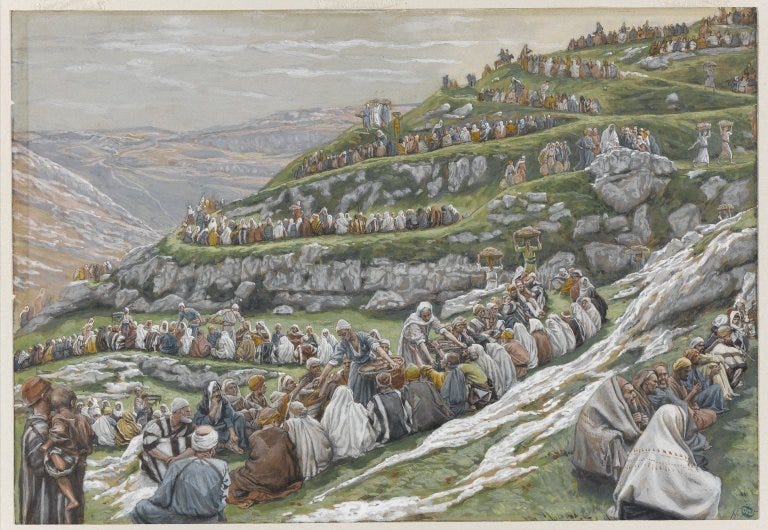
The Miracle of the Loaves and Fishes (La multiplication des pains) by James Tissot, between 1886-1894. Image is in the public domain, courtesy of Brooklyn Museum.
In today’s gospel passage from Matthew, we hear the familiar story of the feeding of the 5,000 or, as it is often called “the miracle of the loaves and fishes.” When we apply common sense, we know that five loaves and two fishes are not nearly enough food to feed 5,000 men, not counting women and children. Yet, somehow, even after all ate and were satisfied, there remained 12 wicker baskets full of scraps!
One popular interpretation of this miracle suggests that the people present actually had food with them, but were too stingy to share until Jesus’s disciples began distributing the loaves and fishes. The “miracle” in this case was that the selfish listeners were moved to generosity by Jesus’s generosity in feeding them. However, while such an account may seem compelling at first glance, it rather removes the miraculous aspect altogether. In other words, this interpretation moves to naturalize the supernatural, to explain away a miracle, to reduce Jesus’s ministry to one of ethical motivation.
Instead, what we find in this week’s readings is almost an opposite movement; we find that the natural is supernaturalized. Five loaves and two fishes were really present, but they became so much more when blessed by the hands of Jesus. They were sufficient to satisfy all present. Meager food became an abundance. The Church has traditionally seen in this a Eucharistic symbol, a foreshadowing of the institution of the Eucharist at the Last Supper, when the simple bread becomes the body, blood, soul, and divinity offered by Jesus through his passion, death, and resurrection. Meager natural food becomes supernatural abundance.
We see this also indicated in the first reading from Isaiah, again showing the abundance of God and God’s desire to satisfy us, not simply meeting our physical human needs of thirst and hunger, but rather the greater human need for life – eternal life – for which our natural needs provide a metaphor. We are more than our physical body and its natural needs; we are body and soul with a supernatural hunger and thirst that can only be satisfied by God. As the psalm response proclaims: “He answers all our needs” (Ps. 145:16).
We are called to be part of this body of Christ, this Kingdom of God. We see that after Jesus blessed the loaves and fishes, he gave them to his disciples to distribute. This work of distributing the food was their task, their human work, done at his command, and done for his glory. And Jesus made so much more out of their work than they could have on their own; he took their natural efforts and made them supernatural. A simple act became a miracle.
Jesus wants to do this for us as well. Paul asks, “What will separate us from the love of Christ?” (Romans 8:35). Regardless of the challenges we face, “In all these things we conquer overwhelmingly through him who loved us” (Romans 8:37). When we are united to him, when we do his command, when we offer our work for him and love as he loved, our simple acts can become miracles. Our natural efforts will have supernatural impact because we, too, are sharers in his mission.
As we begin the month of August and continue to march along the weeks of Ordinary time, this is a welcome reminder to pull us from the ruts of the everyday demands of life. We are made for more because we are more than our natural, physical needs and tasks, and only God can satisfy the yearning that we feel within our hearts. And when we acknowledge this and place ourselves at his service, we will find that we become more than we ever thought possible.
 | A guest post by
|