

Celebrating the Feast of Mary Magdala
How Will We Remember Her?
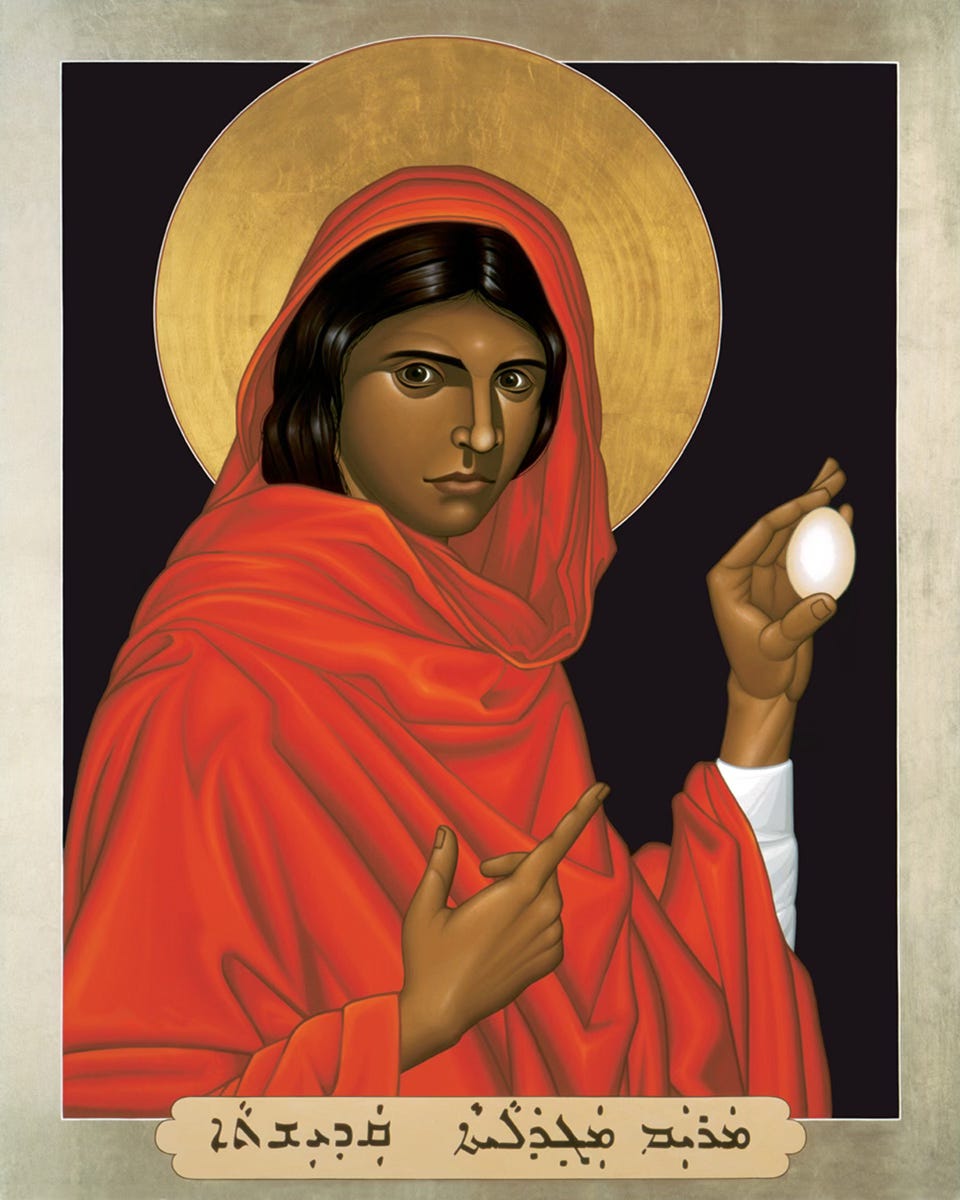
Today, we read the story of Mary of Magdala, John 20: 1-2, 11-18 and celebrate her feast day. Pope Francis elevated her longstanding memorial in the Catholic liturgical calendar to a feast day ten years ago, in 2016, a significant move that places her in a category with only a few other saints and challenges Catholics to remember and celebrate her anew..
In popular Catholic culture, one can find references to Mary Magdalene as the patron saint of repentant sinners, converts, perfumers, pharmacists, tanners, hair dressers, glove makers, and prostitutes.
Even today, some Catholic sources continue to promote the erroneous interpretation (first put forth by Pope Gregory the Great in 1591, conflating different biblical texts) that Mary Magdalene “was known to be a ‘great sinner,’ a woman of the streets who heard Jesus speak of the mercy and forgiveness of God and changed her life completely.”
Thankfully, the new preface written for her feast day uses the title “Apostle to the Apostles” given to her by St. Thomas Aquinas and lifts up the significance of her role in ensuring “that the good news of new life might reach the ends of the earth.”
No scriptural text names Mary as a prostitute, an adulteress, or a sinner. In Luke’s gospel (8:1-3), we learn that “seven demons” were called out of her. Most likely this means that she suffered from some crippling illness—mental or physical—and was healed by Jesus. Then she, with other women, accompanied and supported Jesus as he traveled and preached. She seems to have been a woman of some prominence (as “of Magdala” suggests), an important figure in the early Christian movement.
Today’s gospel is the second half of John’s account of Mary Magdalene, a part never heard by most Catholics who do not attend weekday liturgies, which may contribute to mis-remembering. The gospels disagree on a lot about what happened after the Resurrection. But they agree that women were the first to see the risen Jesus and Mary Magdalene was there, though in Mark and John she is alone while in the synoptics she is among women. Mary’s prominence in the early Christian movement seems to point to her alone with Jesus as the original story.
In the story,there are three key moments that might help us remember her.
She Weeps. She Encounters. She Preaches.
Mary weeps.
Her first thought on seeing the empty tomb is, “They have taken his body.” This is why we find her weeping. Despite what might be inferred from the first reading from the Song of Songs, her tears signal more than passion. Confronted with the empty tomb, Mary draws a reasonable conclusion, out of clear recognition of who Jesus was—a prophet who stirred up the people, ate with tax collectors and sinners, preached good news to the poor and woe to the rich, rode into Jerusalem on a donkey (countering the pageantry and logic of empire), angered the political authorities, and was sentenced to die a humiliating death on a cross.
Mary of Magdala has good reason to think Jesus’ enemies had taken the body, that she had lost the teacher she loved, and she weeps outside his empty tomb.
Early in his papacy, Pope Francis preached in Lampedusa, “We are a society which has forgotten how to weep, how to experience compassion – suffering with others: the globalization of indifference has taken from us the ability to weep! … let us ask the Lord for the grace to weep over our indifference, to weep over the cruelty of our world, of our own hearts”
We can remember Mary by weeping, by being present to the suffering of Christ and that of the “crucified peoples” today.
Mary encounters.
When Mary encounters Jesus, after he calls her name, she recognizes him. In telling her, “Don’t hold onto me,” he isn’t rejecting an embrace. Rather he is inviting her to not to hold onto the way she is used to seeing him (Rabbi, Teacher). Instead, he tells her that he will ascend to God—the God that he and she both know so well--and remain there. He is not dead but remains, not within physical reach but still available to her and to all who believe.
This encounter moves Mary beyond her despair to hope and allows her to live into what she is called to do.
We can remember Mary by encountering Jesus-- in prayer, in loved ones, in strangers, in our opponents, and in the poor. We can strive to contribute to the creation of a culture of encounter in a world torn apart by divisions, and by allowing encounter to transform us.
Mary preaches.
Transformed by encounter, Mary announces the gospel. Improbably, and yet almost certainly, because the early Christians would not make this up, a woman is first to preach the good news, to tell what she has seen and what she has been told. Some gospel accounts tell us this didn’t go well, that Mary and the other women were not believed (Lk 24:8-11).
In the Gospel of Mary, there is a scene where Mary is teaching and Peter interrupts. “Did he really speak privately with a woman and not openly to us? Are we to turn about and all listen to her?” Mary responds, “My brother Peter, what do you think? Do you think I thought this up myself in my heart, or that I am lying about the Savior?” Then Levi interrupts, “Peter, you have always been hot tempered. Now I see you contending against the woman like the adversaries. But if the Savior made her worthy, who are you, indeed, to reject her?”
Though this conversation may be historical, it is more likely crafted to capture the debate over female visionaries and leaders in the early Christian movement.
Mary preached and it bothered people.
Today, Pope Leo continues in the tradition of Jesus and Mary of Magdala, preaching the truth, even when it makes people uncomfortable. On July 4, 2026, he returned to Lampedusa, and, as the United States celebrated 250 years, called the U.S. to honor its heritage by continuing to welcome the immigrants whose sacrifices and hard work have been crucial to its success.
On Mary of Magdala’s Feast Day, we can honor her by remembering her as a disciple of Jesus and Apostle to the Apostles, who wept, encountered, and preached. One of the most significant Catholic saints, she accompanies us even now, calling us to be transformed as she was.