

AI, Magnifica Humanitas, and Sex
The death of "pelvic theology"?
Sunday afternoon, as I awaited the imminent release of Magnifica Dignitatis at 2:30am California time, I wondered what the encyclical would say about family, sex, marriage, and gender. Pope Leo’s recent comments, in answer to a journalist’s question on blessings for couples who are not sacramentally married, seem to suggest that sexual ethics will not be a top priority. He insisted that, “the unity or division of the church should not revolve around sexual matters,” and that social justice issues “would all take priority before that particular issue.” Certainly, his most extensive and prophetic public comments have focused on war, migration, and economic inequality, not sex. In response, many are celebrating a retreat from “pelvic theology,” a movement away from an obsession with sexual rules that defines Catholic morality for many. So, I wondered, “Would the pope’s concerns about AI and human dignity focus on social issues and leave personal ethics behind?
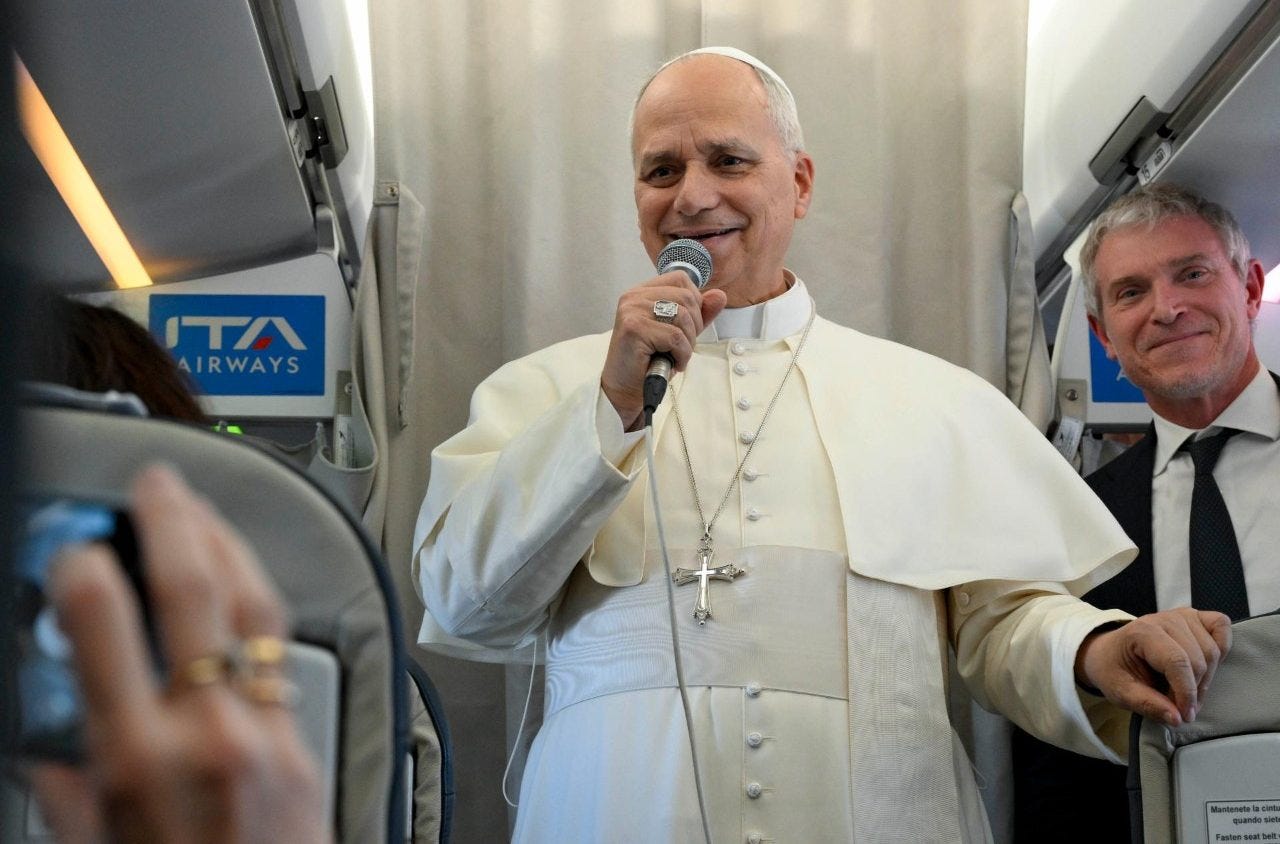
Image from https://www.vaticannews.va/en/pope/news/2025-11/pope-leo-xiv-press-conference-papal-plane-turkiye-lebanon.html
I turned to the 2025 note from two Vatican dicasteries to get a sense of what might be coming. Antiqua et Nova isn’t sex obsessed but it does offer moral wisdom that is relevant for all areas of human life. Instead of giving into a “functionalist perspective” (10) of intelligence based on what it can produce, the note urges a personalist understanding “situated within a personally lived history of intellectual and moral formation that fundamentally shapes the individual’s perspective, encompassing the physical, emotional, social, moral, and spiritual dimensions of life” (32). Though sexuality (56-63) is but one of many ethical issues engaged, the call for “authentic encounter” (57) here is rooted in the same understanding of human nature as essentially relational that animates the entire document. Risks arising in economics, war, healthcare (e.g., deception, abuse, anthropomorphism, isolation, utilitarianism, lack of transcendence, overreliance on technology, lack of respect for human dignity) also pertain to the personal realm. We are made for more and have to remember that AI is ultimately just a tool that must be evaluated in light of how it contributes to or detracts from our humanity.
When I finally read Magnifica Humanitas before sunrise on Monday morning, I found the same reticence about specific sexual issues mixed with deep concern about human dignity and embodied human persons who are made for relationship. Pope Leo decries a “culture of power” and “relational poverty” that both normalizes war (188) and encourages “new forms of slavery,” including human trafficking (175). In the face of currents of dehumanization, he lifts up the goods of attention, care, and taking time to “recognize the other as a face not merely as a function” (114).
Applied to sexual ethics, this suggests that AI tools, like cell phones or social media, are good insofar as they advance our ability to enter into empathetic and genuine relationships, and bad insofar as they impede this. And, as with any major change, it is crucial to see how our thinking is being shaped, how, for instance, interacting with chatbots shapes our interactions with humans. We want encounter, not instrumentalization, in our personal lives as well as our social, economic, and political lives. In this sense, recent Catholic teaching on AI has implications for sexual ethics, even though it offers few specific norms or judgements.
Of course, this is not what most people mean by “pelvic theology,” but I worry that use of this term minimizes sexual harm (e.g., trafficking, intimate partner violence, child sexual abuse, rape as a weapon of war, infidelity, and “bad sex”) and fails to honor the very real need for sexual virtue (e.g., mutuality, equality, fruitfulness, intimacy, self-giving, and self-respect). At least since Vatican II, Catholic sexual ethics has been attentive to much more than rules. To suggest the church has no stake in sexual ethics or that “what happens in the bedroom” is private and unworthy of serious moral analysis makes little sense. It should not, as Pope Leo suggested, divide the church or separate Catholics from one another. It is not the only “grave matter” worthy of moral concern. But who can doubt that the human capacity to harm is present in this realm, as in any other?
For sure, the church still has work to do in deepening sexual ethics and connecting it to a holistic vision of the human person and the good life. The pope might well decide that lay theologians are better messengers of Catholic personal ethics while his power can be best utilized on global socio-political problems. But the personal and the political are always connected and the church does well to help people see those connections. The latest writing from Rome on AI contributes to this project, not by foregrounding sexual ethics but lifting up a vision of a moral life devoted to seeking truth and building a civilization of love, one relationship at a time.