

A Dangerous Mix
Nuclear Weapons and Artificial Intelligence
“Humanity stands at a defining moment in its history.”
This is the first sentence from “Humanity at the Threshold: A Declaration on Artificial Intelligence and Nuclear Weapons” adopted by the participants of the Global Nobel Laureates Assembly on July 16th at the Senatorial Palace on Capitoline Hill near the Colosseum in Rome. Hosted by the Vatican on July 14-15th at Borgo Laudato Si’ in Castel Gandolfo, approximately 200 persons – including Nobel Laureates, AI experts (including Google DeepMind, Aaru, and Anthropic), former heads of state, Vatican officials, religious leaders, and scholars (including myself) – listened to panel presentations during eight sessions and engaged one another during two working group sessions. There were ten working groups, and I was assigned to the one on “Faith Traditions and the Moral Imagination of Peace.”
When nuclear weapons were first being developed, the world had a chance to avoid living in a permanent dynamic of fear. We failed, and as a result, humanity has lived at the edge of nuclear annihilation.
That sentence from the Declaration rekindled a memory for me of feeling such fear in 1983, the year I graduated high school. Ronald Reagan was president of the United States, and Mikhail Gorbachev would soon become leader of the Soviet Union. There were over 60,000 nuclear weapons stockpiled by a dozen or so nations, with around 90% of them belonging to the U.S.A. and the U.S.S.R. Between 1981 and 1984, the Bulletin of the Atomic Scientists adjusted its Doomsday Clock from 4 minutes to 3 minutes before midnight.
In 1983, moreover, two films captured my attention: The Day After imagined what a nuclear apocalypse would look like, and War Games raised concern about supercomputers, hacking, and a false alert that nearly caused a nuclear exchange and World War III. In addition, MTV aired music videos referring to the threat of nuclear war, including Nena’s “99 Luftballons” (1983), U2’s “Seconds” (1983), Men at Work’s “It’s a Mistake” (1983), and The Call’s “The Walls Came Down” (1983). Some of my peers despaired, “Why plan for the future when everything’s going to be blown to bits by nuclear war anyway?” Others of us tried to do something about it, becoming part of the “nuclear freeze generation.”
As bishops and pastors ministering in one of the major nuclear nations, we have encountered this terror in the minds and hearts of our people - indeed, we share it. We write this letter because we agree that the world is at a moment of crisis, the effects of which are evident in people’s lives.
These words are also from 1983, at the beginning of the United States Catholic bishops’ pastoral letter, The Challenge of Peace: God’s Promise and Our Response, which sought both “to help Catholics inform their consciences” and “to make a contribution to the wider public debate in our country on the dangers and dilemmas of the nuclear age.” This “landmark” document stimulated much discussion, debate, and study at the time, and I believe it provided a moral boost to efforts to reduce the nuclear threat.
Indeed, with the end of the Cold War, the lowering of the Iron Curtain, and the Strategic Arms Reduction Treaty (START), the Doomsday Clock moved in 1991 to 17 minutes to midnight, the most minutes since the United States dropped the atom bomb on Hiroshima and another one on Nagasaki in 1945, killing between 110,000 to 210,000 people.
More than eighty years after the dawn of the nuclear age, and at the threshold of the age of artificial intelligence, we are presented with an unprecedented challenge.
These words from the Declaration bring us back to the present. Although the number of nuclear warheads possessed by the world’s nine nuclear powers has declined to approximately 12,000, the most destructive thermonuclear weapon today is 80 times more destructive than the bomb that was dropped on Hiroshima. Even the “low yield” weapons, according to the Union of Concerned Scientists, “are specifically designed to be more usable, increasing the likelihood they may actually be used.”
Additionally, given recent interrelated developments – geopolitical changes, especially with the U.S., Russia, and China; a disregard for and erosion of the force of international law; and what Pope Leo XIV in Magnifica Humanitas calls the “normalization of war” (no. 189-192) and the use of “force without limits” (no. 193-196) – and we find ourselves in 2026 with the Doomsday Clock now “at 85 seconds to midnight, the closest it has ever been to catastrophe.”
In the midst of a worsening nuclear arms race, we are embarking on an equally dangerous AI race.
In the sentence that follows this one, the Declaration refers to Pope Leo’s call in Magnifica Humanitas for an “unarmed and disarming peace” (no. 228). In the encyclical, the Holy Father also addresses the dangers posed by AI and conventional weapons (no. 197-200), as well as “the threat posed by weapons capable of destroying all of humanity” due to “a new arms race, which is hard to control and accompanied by the gradual dismantling of nuclear reduction agreements” (no. 194).
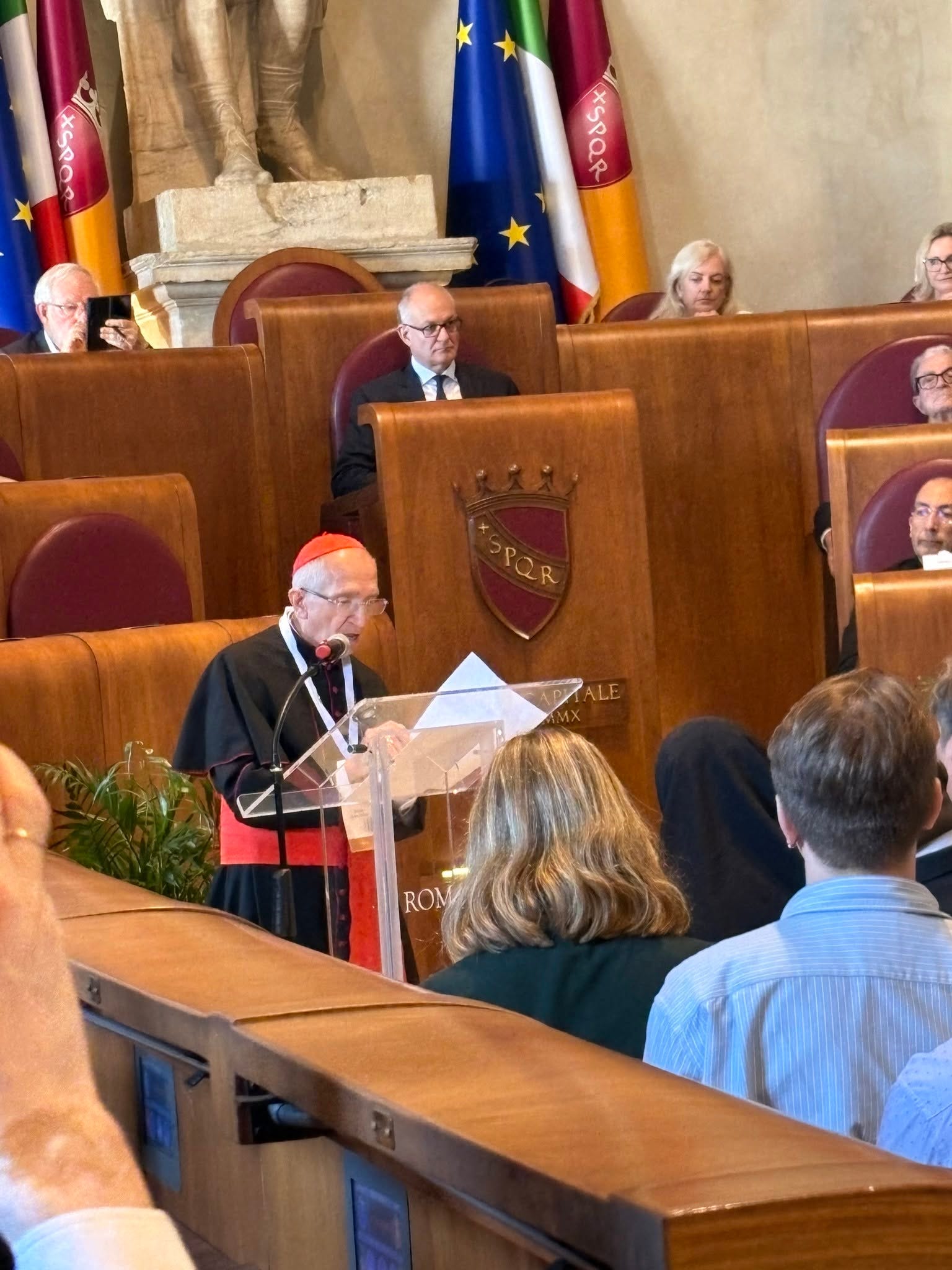
Image courtesy of the author
During the Assembly, we asked hard questions related to the pope’s concern about “the growing ease with which autonomous weapons systems can be deployed makes war more ‘feasible’ and less subject to human control” (no. 197). Guard rails, principles, and the “concrete criteria for discernment” (no. 199) were also frequently addressed. In my working group, we noted that while these are necessary, they are insufficient because there is also the need for moral education and formation in the virtues.
Although there were differences of opinion, the resulting Declaration was a consensus statement, adopting six principles rooted in “our shared responsibility toward present and future generations”:
Disarming the next arms race: “We must disarm the next arms race, both AI and nuclear, before they define the next century as well.”
Responsible development: “AI developers should transparently publish the principles that guide the behavior of their models and be held responsible and liable for those models’ adherence to such principles.”
Responsible use of AI: “We call for the adoption of an international treaty prohibiting the reckless integration of artificial intelligence into nuclear command, control, and launch systems so that meaningful human control is maintained.”
Responsible governance: “We call for expanded research and dialogue to propose new institutional pathways for international governance of AI.”
Responsible leadership: “We recognize that the challenges we face will likely be solved by the next generation of leaders.”
Nuclear disarmament: “Nuclear nations must promote policies and doctrines that diminish the role of nuclear weapons, and reduce the likelihood of first use and catastrophic war.”
For more on each of these principles, I invite readers to turn their attention to the Declaration itself. Here I will only add a word about the fifth principle, because it echoes, to a little extent, input from my working group.
Young people must be empowered to engage with nuclear, AI, and other potentially catastrophic threats, through education, mentorship, intergenerational partnership, and inclusive participation across all regions, cultures, and communities. We must advance education initiatives that foster ethical responsibility, critical thinking, media and AI literacy, and a culture of peace.
During our working group’s meetings, Rabbi David Rosen reminded us that we cannot assume that human control is necessarily good either. We are fallible and we can choose not only to do what is morally right but what is morally wrong. On this I added the need for moral formation since the fostering of ethical responsibility and the building of a culture of peace, or the “civilization of love” that Magnifica Humanitas promotes (no. 185), requires more than principles, criteria, and guardrails.
It is not our intent to play on fears, however, but to speak words of hope and encouragement in time of fear.
In 1983, the U.S. bishops wrote these words, and forty-three years later they were on my mind during the Assembly. To be sure, some of the speakers inspired hope, such as the Filipino American Nobel Peace Laureate Maria Ressa who one of two speakers receiving a standing ovation after their address (the other was Cardinal Silvano Maria Tomasi). But there also were dire warnings given by others that did not dissipate the fear. David Gross, who received the Nobel Prize for Physics in 2004, more than once spoke to the young persons in attendance, saying, “If young people were informed of the current danger … they would again be marching in the streets.”
I confess that what Professor Gross and others shared about the magnitude of the danger posed by nuclear weapons, compounded by AI, left me feeling not very optimistic about the present and the future. Yet, on the other hand, I met several young students from the University of Notre Dame’s Catholic Peacebuilding Studies program, directed by Gerard Powers who was also a participant in the Assembly (while I’m at it, I recommend the program’s Project on Revitalizing Catholic Engagement on Nuclear Disarmament). While I would emphasize the intergenerational partnership in the fifth principle, the serious engagement of these young people inspired hope. Others there did so, too. That so many persons from so many places and with so many perspectives gathered together to address the current danger we face also gave me hope. Of course, hope is not the same as optimism, but it can save us from despair.
Indeed, hope is mentioned in Magnifica Humanitas many times, including in its final paragraph: “let us become ‘weavers of hope’ in our world, sharing who we are and what we have, so that the presence of Jesus may grow among us and his Kingdom take shape” (no. 245).
 | A guest post by
|