

6th Sunday of Easter
Loving Jesus in His Commands
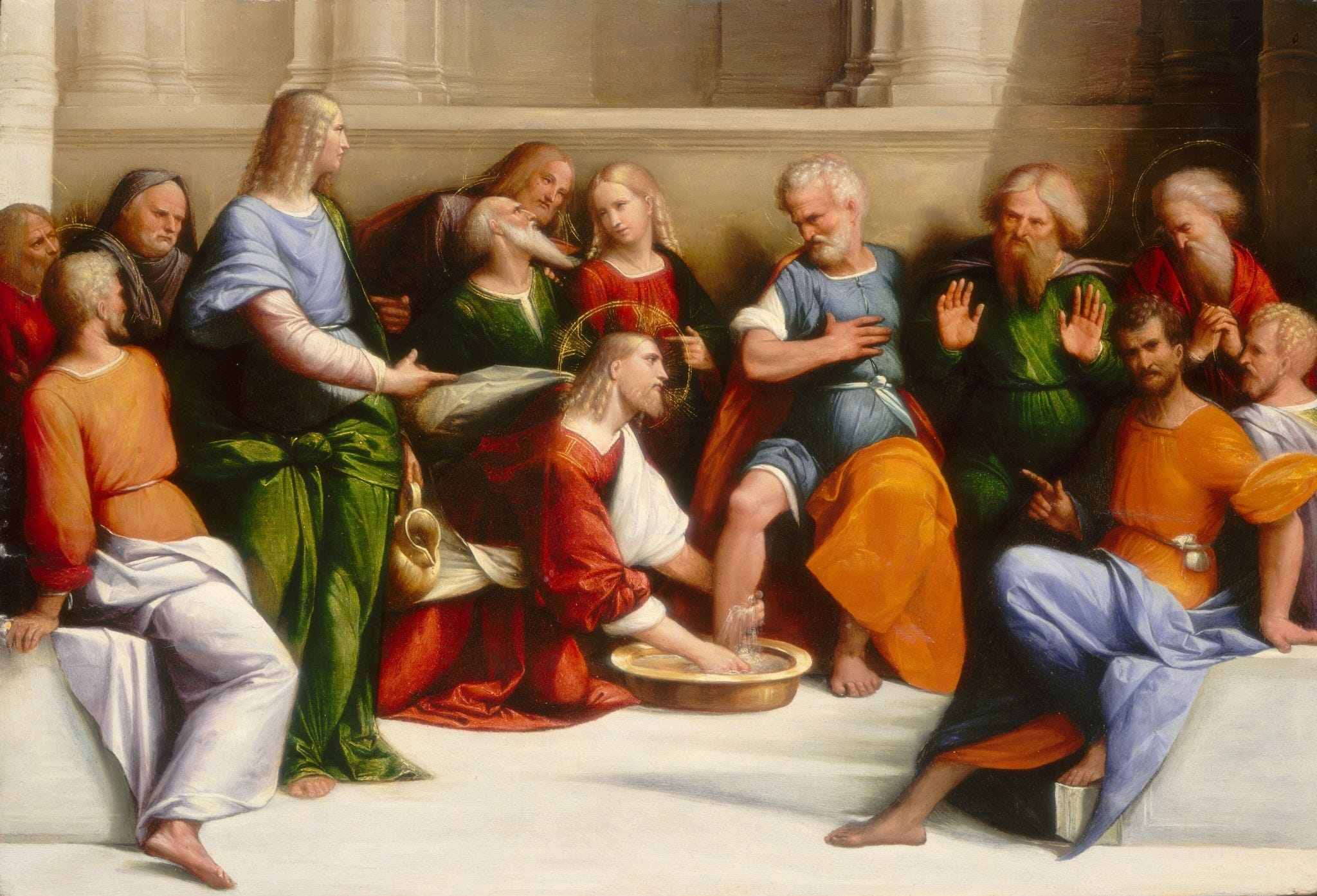
Image: Christ Washing the Disciples’ Feet by Garofalo, ca. 1520/25, in the public domain from the National Gallery of Art Patrons’ Permanent Fund.
Readings for the Sixth Sunday of Easter can be found here.
We are drawing near to the end of the Easter season, as next Sunday we will celebrate Jesus’s Ascension, with the following Sunday devoted to the coming of the Holy Spirit at Pentecost. Our gospel passage from John Chapter 14 today foreshadows this when Jesus mentions the Father will send another Advocate, the spirit of truth. Likewise, our first reading from the Acts of the Apostles also highlights the Holy Spirit, recounting that Peter and John prayed for the Samaritans to receive the Holy Spirit, and they did (Acts 8:14-18).
Yet if our eyes are looking ahead to Pentecost in a fortnight, nonetheless the immediate context for today’s gospel actually places us within the Last Supper discourse, with Jesus celebrating the Passover with his disciples. The previous chapter of John features the account of Jesus washing the disciples’ feet, and we find a common theme extending throughout these chapters and presented by Jesus in the foot-washing: “I give you a new commandment: love one another. As I have loved you, so you also should love one another” (13:34) and echoed later: “This is my commandment: love one another as I love you” (15:12-13).
This theme is crucial as we consider Jesus’s words that bookend today’s gospel. First, “If you love me, you will keep my commandments” ( John 14:15) and then, towards the end, “Whoever has my commandments and observes them is the one who loves me” (John 14:20). The interesting wordplay is almost like a logic puzzle; we could spend hours reflecting on the phrasing of these sentiments and how they differ–why they were presented again in a different formula. We add another piece to consider when we hear Jesus emphasizing that his commandment is to love one another.
The focus on love might seem to accord well with modern sentiment; from Valentine’s Day to the plethora of rom-coms to the words of Taylor Swift: “don’t we try to love love?” Yet contemporary and secular understandings generally pale in comparison to Jesus’s robust understanding of love: to lay down one’s life for one’s friends (John 15:13). This love is not primarily about warm, fuzzy feelings or sweet words, but a choice to sacrifice one’s desires or needs for another’s good.
Very often we hear moral advice that pits “love” against “commands” or dismisses moral rules in favor of “love.” Sometimes it’s even phrased in terms of “being authentic.” Yet, what our Church teaches us is that the rules or commands are meant to facilitate our love and our freedom. True freedom and love are not found in capricious choices based on the haphazard whims or fluctuating emotions of life, but on the intentional decision to follow Christ and to love as he loved, despite the cost. Jesus’s own words confirm this: “the world must know that I love the Father and that I do just as the Father has commanded me” (John 14:31). Here Jesus does not announce that he lacks freedom, but shows that freedom is doing out of love what the Father commands. We hear it again in the Garden of Gethsemane: “Father, if you are willing, take this cup away from me; still, not my will but yours be done” (Luke 22:42).
One interesting consideration here – appropriate since the gospel passage is part of the Last Supper discourse, linked to the Eucharist – is the Sunday Mass obligation. The Church requires Catholics who are able to attend Mass on Sunday. This is not intended as a restriction on our freedom, but as a way of facilitating our freedom to love God and one another. Some may suggest that the important task in life is just to love each other, not to sit in a pew for an hour on Sundays. Yet it is precisely the communal celebration of the Eucharist that is uniquely able to sustain us for the task of sacrificial love. Others may say that “they don’t feel like it” and thus it’s hypocritical or inauthentic to attend Mass. Of course, the ideal is to want to go, to attend Mass out of heartfelt desire, motivated by love for God. Yet, the choice to attend Mass when we aren’t feeling it demonstrates a sacrificial love born of commitment: “not my will but yours be done.”
In fact, we have many obligations that ought to be occasions for loving and serving others: our daily professional work, our presence with our family, our daily tasks of life. Often we fall short of the intention of loving, sacrificial service. However, few of us will decline sending the email, taking out the garbage, getting up with a sick child at night, or brushing our teeth because we just aren’t feeling the true motivation of love. Instead, we remain committed to our duties and seek to rectify our intention as best we can, reminding ourselves why we do what we do.
And this is where we can return to Jesus’s promise of the Holy Spirit. The Holy Spirit helps us to love and to keep the commandments. Of course we will not always have perfect intention, and we will often fail at loving as Jesus loved. We sometimes will choose to sin, whether because we aren’t recollected and purposeful or because we just want to do what we want, without reference to what God calls us to do. We may feel like hypocrites: able to make ourselves go to Mass out of obligation, but nonetheless sinful and impatient with others. Yet even this flaw reminds us of our dependence upon God for redemption. We have already been saved by Jesus’s choice for the cross, the will fully aligned with the Father’s will: “Put to death in the flesh, he was brought to life in the Spirit,” as we hear today in 1 Peter 3:18.
Through that love, we are redeemed in the resurrection that we still celebrate in this Easter season. Our sins do not lead us to despair, but to healing repentance and conversion. And we are not left alone, but sustained by Jesus’s body and blood, soul and divinity in the Eucharist. We are guided by the Holy Spirit, who will help us to love God by following his commands, and in this, we will find the freedom of friendship with God.